
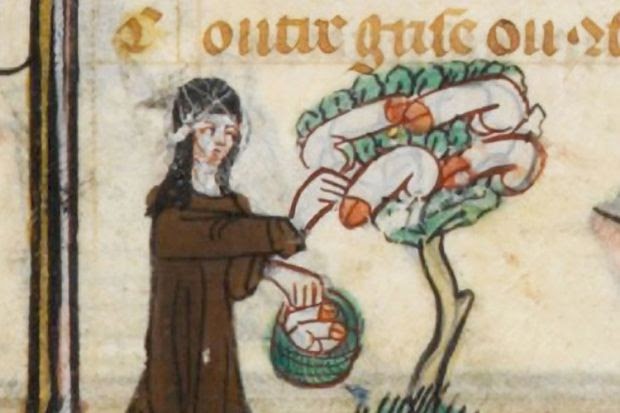
In my day job teaching British Lit to high school seniors, I spend a lot of time talking about words, both sweet and salty. To distracted seventeen and eighteen year olds, the scatalogical and sexual humor of medieval and Renaissance literature is compelling and entertaining, and they are shocked that people so long ago wrote such salacious literature, as if teens in 2023 have invented every dirty thought that ever existed. When reading Middle English texts like The Canterbury Tales, we discuss the choice expressions Chaucer uses, the ancestors of today’s “four letter” expletives, pointing out that curse words and other offensive language are some of the oldest relics from Anglo-Saxon, the language spoken by the residents of England before the Norman invasion in 1066. These colorful oaths remain even as our language evolved because peasants, who spoke Anglo-Saxon the most, continued to use these low class euphemisms which eventually found their way into texts by Chaucer, master of the vernacular. This notion fascinates me, that George Carlin’s seven dirty words are as much our heritage as the crown jewels. Seniors are scandalized when I hint at some of these expressions–I don’t even need to say them– , and thanks in part to this, they certainly aren’t sleeping in class.
So when I heard about the new book from Jess Zafarris, Words from Hell: Unearthing the Darkest Secrets of English Etymology, I knew I had to read it. The inside cover promises, “If it’s inappropriate, stomach-churning, uncomfortable, or offensive, this book reaches into the dark recesses of history and exposes them for all to see.” Sign me up and call it professional development. A cross between a glossary and a history of English, one doesn’t need to read it cover to cover to appreciate the thoroughness of Zafarris’ work. Dip into chapters about obscenities, slang related to the body, or insults, among other more politically charged topics to read her remarkable research on the origins of obscenities. For we only have to hear Trump say, “Grab ‘em by the p—-” to know that vulgarities, used with vitriol and swagger, can wield the power of privilege and the patriarchy to cause irreparable harm.
In fact, as an indication of exactly who is in charge, so many words for “phallus” exist in our language that, as Zafarris writes, an entire book could be written about only that topic. Some colorful antiquated synonyms she highlights that, in my opinion, deserve to be resurrected include “caramba” (appearing in the seemingly innocent phrase “!Ay, caramba!”) and the more banal “choad,” which sounds more like a type of tree frog. Incidentally, the word “phallus” derives from the Greek word “phallos” referring to actual penises and carvings of them used in Dionysian worship, a pervasive fascination that has permeated every part of ancient Western culture. As my tour guide told me on a trip to Pompeii, over 40 images of phalluses can be found carved and painted onto surfaces, and I doubt those were created by women. One might even say that men have been obsessed with the glory of their masculinity for as long as men have ruled civilizations.

On the other hand, the book offers a different view of the words for female genitalia, demonstrating that these terms are more nuanced, and often defined by their relation to the male organ, such as with some euphemisms derived from archaic language meaning a “pocket” or “sheath,” presumably to hold a weapon. Over hundreds of years, these terms which had previously been matter-of-fact, or even positive, gradually became taboo in an increasingly conservative society. They insulted effeminate men, compared women to small mammals, and often flourished in the sex trade, where men commodified the power of female sexuality for their enjoyment and profit. These words are some of our most offensive terms, perhaps because female genitalia, and therefore women, were kept under wraps, hidden behind closed doors, a gazillion layers of clothing, chastity belts, and strict codes of conduct. Even use of these terms by women is frowned upon (in the eyes of men, presumably), making the words’ existence doubly oppressive. Ladies, the next time someone accuses you of having a potty-mouth, just tell them you’re just doing your duty to fight the patriarchy and invite them to join you.
In another chapter, Zafarris relates a shorter history of some words in the LGBTQIA+ lexicon, such as “transgender” and “pansexual,” reflecting new terms for the broad spectrum of gender and sexuality that has reclaimed slurs and invented words to articulate the new attitudes towards and understanding of this aspect of human behavior. She writes that some pejoratives, such as the “f” slur for gay men, initially referred to women, and only became used for men exhibiting effeminate behavior as it implied they were lesser and therefore like women. It is no surprise that men in positions of power could craft a word that simultaneously oppressed two groups of people. How efficient! Zafarris further asserts that “[d]ue to the fragility of hypermasculine self-expression” there is no shortage of disparaging words for relations between men, but it was only through the Pride movement that some of these terms, such as “queen,” have grown to be terms of affection and power. I love that Rupaul can help make that happen.
The impact of words becomes most obvious when Zafarris talks of insults. Pretty much anything can be an insult, she says, when delivered in the right way. One only needs to look at Shakespearean insults to see nonsense words hurled at one another to a surprising effect. I don’t know what a “crusty batch of nature” is, but I might be pretty upset if someone called me that on the internet. What I found most interesting is that many of the insults she describes reflect sexism, homophobia, and gender bias ingrained in our language such as terms for women based on their being oversexed, undersexed, the wrong class or race, or having a bad attitude. Likewise, Zafarris addresses the topic of racial slurs and their changing usage, how even the name of the country of Niger and the other words that even sound like the n-word become problematic, as it remains, as one linguist calls it, “twenty-first-century English’s Voldemort term.” However, in its accepted use by certain people in certain circumstances, it becomes a very effective expletive. Additionally, she points out the ableist slang as well as disparaging terms for mental health that permeate our culture. “Crazy,” “psycho,” and “bonkers” become loaded expressions when we look at their origins and intent, but unlike other taboo words in this book, it certainly won’t keep us from using them.
The remaining chapters of this book discuss fewer hot-button issues, but are still interesting, such as her discussion of terms related to drugs and booze, crime and scandal, violence and weaponry, followed by witchcraft and the supernatural. For word nerds, there is no shortage of esoterica and “um, actually…” knowledge sure to annoy your friends. Will this book be displayed on a shelf in my classroom? You bet. Will I loan it out to students (many of whom are old enough to vote)? Absolutely. In fact, in a Gen Z world and internet culture where obscenities are thrown around with abandon, we owe it to ourselves to know the origin of these words to acknowledge their weight and heft so we don’t become immune to them. Words have the potential to help or harm, to lift up or oppress, and the sooner we can reclaim some of the most offensive, the better. Maybe there aren’t enough pejoratives about straight, white, able-bodied men to fill a book, but we can be aware of the power of language as it is used to marginalize and subjugate. If only the “sticks and stones” aphorism were true, the world would be a very different place. Jess Zafarris, however, manages to diffuse these linguistic bombs one by one, dismantling meaning so we can examine language as the organic barometer of society’s values rather than a weapon designed to put people in their place, and, in the lingo of Gen Z, I am here for it.
Leave a Reply