


Warning: spoilers follow for the second season of The Pitt on HBO.
The Pitt may have lacked subtlety. Its realism made up for it.
This season, attending physician Dr. Michael Robinnavitch built less and less good will with viewers and his staff as he snapped more and more the closer he got to ending his shift,, taking a break, and starting his sabbatical on a motorcycle drive across the country to a place more known for Buffalo being driven off a cliff than a summer vacation.
As the presents eloquently,, Dr. Robby needs a break. And a lot more. He faces not only a crisis of stress with being a the head doctor at an emergency department at a trauma center in a major metropolitan United States’ city, but it has coalesced into a question of worth and suicidal ideations. He finally admits to his friend Duke in the penultimate episode that he doesn’t want to “be here.” Duke first interprets it to mean amidst the chaos of the emergency department where the influx never stops, where viewers know it can shake the best of the nurses and doctors..
“I don’t know if I want to be anywhere,” he sobs.
And that’s how it feels.
On March 26 of this year, I looked into the future as perfectly as any other person, and, while death still scares me, that day, it felt like a way for me to take control of something which appeared bleaker
The ideas did not start on March 26, though.
Unknown to me, death by one’s own hand seemed like the natural progression of life. When I was a child, life felt like it should be over when I said it was over, when I was done. It didn’t help that I was bullied with antagonizing infrequency. I never predicted what would come or when.
“I don’t know if I want to be anywhere,” he sobs.
Later, life improved greatly. Other than a short few years with antidepressants in college, things rolled smoothly. I felt more confident, thanks to drinking and friends.
Then college ended, and with it, bills. Real life. Stress. Troubles far and wide, loneliness in a crowd chief amongst the complaints. The suicidal ideations came again, and while they felt hazy, a loose plan was there. It was a plan that inched closer by the months, then suddenly, by the days and the hours.
Dr. Robby begins his 4th of July shift at 7:00 a.m. notably driving into work on his Indian motorcycle without a helmet.
A series of patients lets him and the nurses know that Dr. Robby may have some issues: someone comes in after wrecking a motorcycle in a stunt, albeit with a helmet, which saved his life; a baby is abandoned in the bathroom; a lonely homeless man distanced from his own daughter spends most of his day in the ED; all while Dr. Robby loses his cool more often than not.
Robby shifts uncharacteristically from teacher and mentor to adversary and emotional abuser.
Like a lot of men, sadly, both Dr. Robby and I have depression that manifests as anger long before it transitions into sadness, loneliness, feelings of abandonment, and then the weighty feelings of tired, sleepy, and resignation.
Luckily for fans of The Pitt, Dr. Robby wanders the halls of the ED long past his shift ends. He looks from room to room for those with whom he has loose ends: Dr. Al-Hashimi, Dr. Samir Mohan, and Dr. Langdon. Head nurse Dana warns Dr. Abbott – Robby’s emergency contact – that Robby admitted earlier that he wasn’t sure if he’d come back, and it didn’t seem like he was quitting the job, either.
It’s how it plays out, at least for me and the fictional Dr. Robinnavitch. It does not mean there isn’t a lesson to be learned. That lesson, and the intense realism more present in the second season, makes The Pitt one of the top shows of television for the last two years.
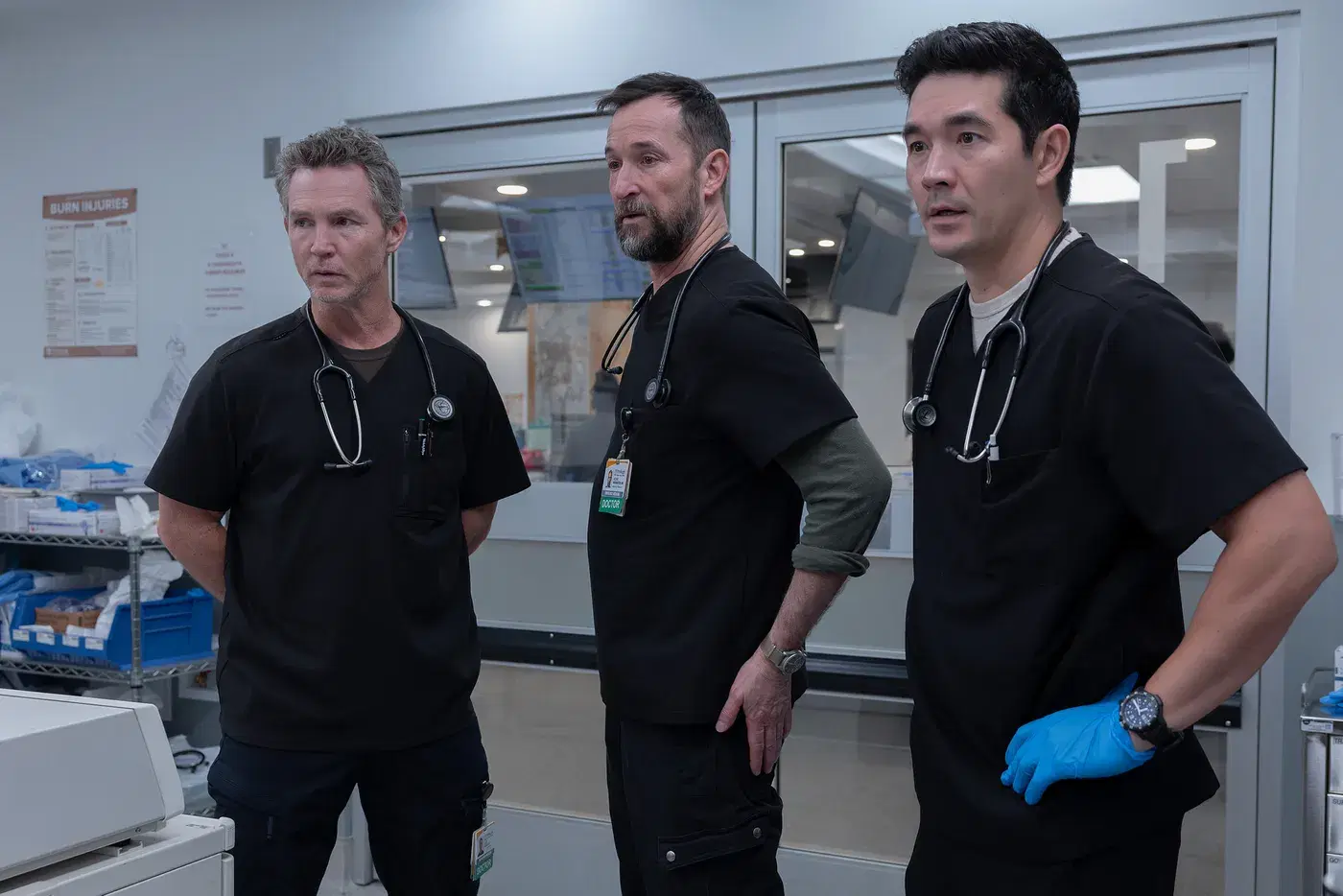
Doctors Abbott (Shawn Hatosy), Robby (Noah Wyle), and Shen
It starts as anger. You’re out to get me; fuck you; I can handle this; why isn’t anyone helping me. After you’ve shoved enough people away from the anger, you mope. Why are they gone; why doesn’t anyone love me; I’m a failure; I’ve let them all down; they all hate me. From there, it fluctuates from sadness, loneliness, and the more common symptoms of depression: sleeping more than usual; avoidance; tears.
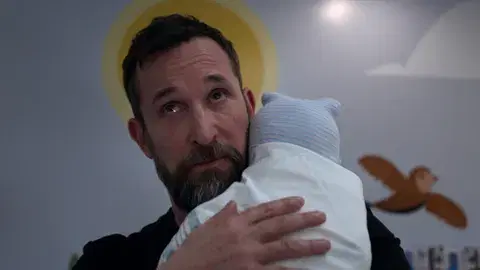
Once the tears begin, as it did with Dr. Robby in much of the finale, it’s not the end. There’s hope. Most people who commit suicide don’t want to die. They want a problem or three solved.
That’s it. And while you may not be there to solve it, you can share what you’ve gone through. And if it’s not the time to talk, it’s always time to listen. Ask how they’re doing. If they avoid you, wait a little while. Use your judgment. They’ll open up the next time. If not then, sooner than later if you ask without pestering.
Listening won’t fix everything. The person will need help in the form of therapy, medication, or both. I needed both.
Note how Dr. Robby started to break through with Duke and just before with Dana. One was his friend, the other was his mother figure. Mark how with Duke, he didn’t argue. With Dana, he did, but he also admitted for the first time on the series that he was abandoned by his mother. Later, as he cradles a baby, he tells the infant Jane Doe that he was eight. That’s a rough time to feel left alone by a mom. No wonder he gets snippy with Nurse Dana early in the season and continues to do so until he’s almost broken their relationship.
Those steps are also a look into the sort of depression some men face. They push away and get cruel until the ones who care the most are the same who are locked out. It’s easier that way for the depressed, myself included. If I feel like no one cares, I need to prove it in reality. Then I can solve the problem myself.
In the final episode of the season – a stellar one by most standards – Robby admits to Dr. Mohan that not only was he abandoned by his mom when he was eight, but he also imagined he would have two kids, a wife, and a pond. He has none of that dream. It makes him feel without a purpose, weak, alone.
Admitting it, though, moved a mountain. And maybe for Dr. Michael Robinavitch, there may be a pond behind it.