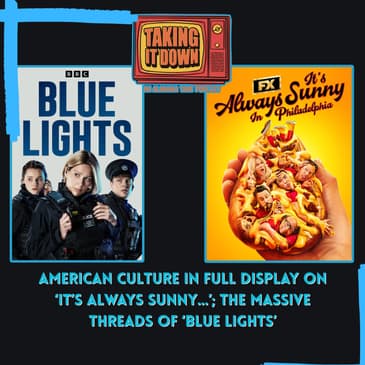





After an overview of the podcast (0:02) and a preview of this episode (0:27), Blaine welcomes Adam and Donovan to the show (1:05).
This week, they begin the non-spoiler section with broad thoughts on how 'It's Always Sunny in Philadelphia' serves as a satirical mirror of American culture (1:48). After that, they discuss how 'Blue Lights' stays intelligent and captivating with its fresh perspective (14:28).
In the spoiler section, Blaine and Donovan break down the specifics of what made 'It's Always Sunny...' a return to form, particularly the finale (24:06).
They then discuss - with spoilers - the evolving production quality of 'Blue Lights' for its finale of season one and its beginning of season two; plus, its deeper storytelling (35:49).
For more, visit The Alabama Take website with this link.
To sign up for the site's newsletter, visit the link here.
To help both the podcast and The Alabama Take site itself, consider making a donation of any size with the link here.
Hey, everyone.
Speaker AWelcome to Taking it Down.
Speaker AWe're the streaming and TV podcast for the Alabama Take website.
Speaker AWe're here to dissect TV for you, but before we do that, we offer up our ideas on if you may like it or not.
Speaker AWe'll do that without spoiling anything.
Speaker AIn the first 10 to 15 to 20 minutes of the episode, use your time stamps to follow along there.
Speaker ABy the end of the episode, you'll know if this season of It's Always Sunny in Philadelphia was for you or if the entire show is for you or not, if you've never started it, as well as Blue Lights, which is streaming on hbo.
Speaker AMax, we have finished the first season of it.
Speaker AWe're talking about the second season a little bit in spoilers.
Speaker ABut before we do that, we will let you know what we think you might take away from it.
Speaker AJoining me today, as always, it's Adam.
Speaker AIt's Donovan.
Speaker ALet's invite them in.
Speaker BAlabama take projection.
Speaker AHere they are, as promised.
Speaker AHey, it's Adam.
Speaker AAdam's back.
Speaker AAdam's back from his Tuscaloosa show date.
Speaker AAnd Donovan's here.
Speaker APer usual, Adam played Druid City Brewery, whom we are not sponsored by.
Speaker CThat's true.
Speaker AThere's no lies.
Speaker CI love that.
Speaker CIt's been, like, over a week since I played there, and you're like, he's back.
Speaker CAs if, like, there's an Oregon trail between me and Tuscaloosa that I had to navigate.
Speaker AYou weren't on last week's.
Speaker AI know last week's podcast, so, yeah, there you go.
Speaker CI don't walk home, though.
Speaker CI am.
Speaker ARide your horse home.
Speaker CYeah.
Speaker ABut let's dive into it.
Speaker AI have been trying to get a couple of friends to begin watching It's Always Sunny in Philadelphia.
Speaker AI can think of two off the top of my head.
Speaker AThere might be a third friend.
Speaker AAnd this season, which just ended, is another example why we're in non spoilers.
Speaker AAdam's not caught up on it, but that's okay because we're in non spoilers.
Speaker ADonovan, what would sell people?
Speaker BLike, you know, we've kind of gone around and around on this, and I do think for the hesitant.
Speaker BOne thing I do think this is true is that you would be surprised at the cross section of people who like this show.
Speaker BFolks that you would think would usually see something like this and be like, this is not for me.
Speaker BThis is not my kind of humor.
Speaker AWho are.
Speaker BLove it.
Speaker ALike, who would look at this and go, oh, no.
Speaker AWell, I think the title turns some people off.
Speaker BYeah, like, My wife doesn't necessarily, like, love very, like, kind of brash, crass humor, but she loves Sunny.
Speaker BLike, there's episodes we'll watch and we'll just be dying at the antics of the characters.
Speaker BI do think get over the title.
Speaker BThey came it up.
Speaker BThey clearly came up with it while they were high.
Speaker BSometime in 2005.
Speaker BYeah, pass.
Speaker BLet that pass by.
Speaker AI mean, Adam's a fan.
Speaker AHe just.
Speaker COh, I'm a huge fan.
Speaker AYeah.
Speaker CI thought you were gonna say your wife was.
Speaker CWas not into it because she is a female who went to college between the years of 2007.
Speaker AYeah.
Speaker C2011, 12.
Speaker CWell.
Speaker CAnd we were, you know, fairly insufferable.
Speaker CIt's.
Speaker CIt's so funny, though.
Speaker CDonovan, I think I've said this on the show before, was one of the very, very early adapters to this program.
Speaker AHe was.
Speaker CHe watched season one and then was there the day that season two came out.
Speaker CHe had, like, announced to the the apartment, like, hey, I'm watching this tonight.
Speaker AYes.
Speaker AI remember Steve Kowalski in Egan's Barkeep and Doorman and Egan's telling me that was a good show.
Speaker AAnd this would have been 05 06.
Speaker CI can't believe that it's had the longevity that it's had.
Speaker A17 years.
Speaker AIt's the longest scripted non animated television show.
Speaker BAnd to that point, too, I think if reluctant watchers, you know, the whole thing's pretty good.
Speaker BBut if you dive in in the later half, they are really comfortable with each other.
Speaker BThey really, really know their beats.
Speaker AYeah.
Speaker BLike, sometimes it's just.
Speaker BIt's just like a comedy machine being set into action.
Speaker AI sell people by saying, it is the only show I know of that I watch and has always made me laugh out loud.
Speaker ALike, not just chuckle, not just smile.
Speaker ABut I literally.
Speaker AThere's always a moment or two or three where I just bust out laughing.
Speaker CThere are moments that if I start thinking of them, I'll.
Speaker CI am, like, laughing right now, kind of playing, like, the greatest hits.
Speaker AYeah.
Speaker CIn my head.
Speaker BYeah, same.
Speaker BLike, there's a bit in one of the episodes where, like, Frank keeps flushing his clothes down the toilet and Charlie's trying to keep everything together, and he's walking by and Frank's got a roller of black paint, and Charlie's like, what are you doing?
Speaker BHe's like, I'm painting a shirt.
Speaker BReluctant listeners, if that doesn't convince you.
Speaker AIt'S kind of the Waffle House of shows.
Speaker AYou love it late at night, maybe after some drinks or just some drugs or something.
Speaker AOr maybe just, you know, it's late at night and your cares are done.
Speaker AIt's so good at that 9 o' clock moment.
Speaker AAnd I've got 25 minutes to kill and I'm going to watch it.
Speaker AAlways sunny.
Speaker AIt really hits the spot.
Speaker BAbsolutely.
Speaker AWash the world away.
Speaker AThey are often dealing satirically with the world, but.
Speaker ABut it's always such a funny way of doing it.
Speaker AThey're so self.
Speaker ASo unselfaware.
Speaker AThey're not self aware.
Speaker AMaybe a little.
Speaker AThey get a little more self aware each season, but it's.
Speaker AIt doesn't change their behavior.
Speaker ANo.
Speaker BThe preening narcissism never leaves.
Speaker BAnd I.
Speaker BIt's not the same kind of show as Arrested Development, but I do think that it has that element of characters like.
Speaker BLike Job or.
Speaker BThat are just black holes of narcissism, and it's just hilarious to watch them.
Speaker BThis.
Speaker BThis show may be a whole show of Jobs.
Speaker BThat's not entirely true, but that's the thing that you.
Speaker BI think there's some crossover to that kind of.
Speaker CYou know, I'm always interested in things that, like, kind of seem stereotypical or blase now, but at the time were kind of shocking.
Speaker CLike, this show, when it first came out was the big selling point was like, oh, it's Seinfeld.
Speaker CBut if they all let their inhibitions down and became like even worse versions.
Speaker AOf themselves, it sounds a little bit shocking.
Speaker CYeah.
Speaker CLike, it was.
Speaker CIt was pretty out there in its context.
Speaker BThere's an element of both of these where they're just kind of undercutting capital M myths that we tell about ourselves.
Speaker AOh, that's good.
Speaker BI don't think I could tell you more than that because that sentence just popped into my brain and I said it, but I do, you know, Arrested Development very, very obviously.
Speaker BRight.
Speaker BWhat's it dealing with?
Speaker BIt's a satire on the Bush family.
Speaker BIt's about the Iraq war.
Speaker BI mean, at the time that they did these episodes, you know, people were getting killed in Iraq.
Speaker BI mean, they still are in some places, but you know what I mean?
Speaker BAnd then with that, I don't care.
Speaker AAbout their killing in Iraq.
Speaker AI will say that there was like, you know, I was talking about the UN Self awareness.
Speaker AThere was a moment in the penultimate episode of this season where a character is speaking with a black accent and he's not black.
Speaker AAnd then the other characters look at each other and think, we're not supposed to do that, are we?
Speaker AAnd they're.
Speaker AThey're saying, no, I only did it because he did it.
Speaker AI'm only mimicking him.
Speaker AIt's just dumb.
Speaker BIt's so good.
Speaker ADumb.
Speaker APeople acting dumb can be very rejuvenating.
Speaker CIt's so great.
Speaker BLike there's something about like the almost awareness of that they have of the way that we as human beings should live our lives.
Speaker BAnd sometimes that should is a real should and sometimes that should is a end quote should.
Speaker BLike they got the idea, you know, like in the first episode of this season.
Speaker BThis is a tiny spoiler but I think it's a good example.
Speaker BCharlie's like, oh well, white people aren't supposed to save people anymore.
Speaker BThat's a white savior.
Speaker BAnd like so they kind of like they just get it filtered through this prism where you can kind of kind of laugh and think about like what.
Speaker BWhat are we actually mean?
Speaker BWhat do we tell ourselves?
Speaker BMax use of the word woke for years has, has has presaged the.
Speaker BThe fact that this week people were like minimalist font is woke.
Speaker BAnd we're going to.
Speaker BAnd we're going to take you down.
Speaker B200 million at the stock market.
Speaker ACracker barrel.
Speaker BIt's.
Speaker AThat's it though.
Speaker AI think you've nailed it.
Speaker AIt's really dumb.
Speaker APeople who only have like the sliver of knowledge that most people have and you see these people in day to day life.
Speaker AGod for you know, you really do.
Speaker AWhere they have.
Speaker AThey know something about the word woke or.
Speaker AOr they know something about the word white savior and that's it.
Speaker BExactly.
Speaker BIt's so good.
Speaker BJust because like again like they have this sort of idea that there's a standard to human beings as human beings they should live up to but not a one of them.
Speaker BAlthough, although Charlie, Charlie's probably I think the best of them.
Speaker BThat's my assessment.
Speaker BCharlie's almost got a sweetheart.
Speaker CNo, he's the wild card.
Speaker BHe's the wild card.
Speaker BAnother classic so good.
Speaker ANone of their knowledge or self awareness, if they have any, is going to interfere with their selfishness and getting what they want.
Speaker BAbsolutely.
Speaker BAnd I think that's another area where it is sort of a prism of a consumerist, individualist society.
Speaker BEverything is going to ultimately bend right back on them.
Speaker BThey can justify anything, they can do anything.
Speaker BThey will never learn.
Speaker CIt also does a thing to explore that idea where and I haven't seen the most recent season, I just love that this is always a joke that they will pair up differently or group themselves to accomplish.
Speaker CSo they're not loyal to anyone.
Speaker CIt's just understood that they're always competing with one Another on some level and doing whatever it takes to accomplish this dumb goal.
Speaker BYeah.
Speaker AThey'll step on each other if that's what it takes.
Speaker BYeah.
Speaker BThere is no honor among thieves.
Speaker BThat's so true.
Speaker AWe're going to shift eventually into a show in Northern Ireland.
Speaker AAnd if someone from Northern Ireland were to come to me and they haven't watched any American television and they knew very little about the United States, and they said, what show kind of preps me for how Americans act?
Speaker AI'm not so sure I wouldn't show them.
Speaker AIt's always Sunny in Philadelphia.
Speaker BYeah.
Speaker BIt's like having the national ID on display.
Speaker BAnd I think we've seen.
Speaker BI think we've seen in the newspaper the national ID on display, and it's not far from what is being filmed.
Speaker AYeah.
Speaker AThis person asking the hypothetical would have to also not pay attention to the news.
Speaker BYes.
Speaker BIt's like the real show you want to watch to discover what America is like.
Speaker BIs any CNN broadcast.
Speaker AThis most recent season is their 17th.
Speaker AIt's the the longest running scripted television show.
Speaker AI bring this up once more because it was one of the better ones in the last five or six seasons.
Speaker BI'd agree with that.
Speaker BI had some.
Speaker AThere were.
Speaker BSo Blaine, we talked about them a little bit, but some of the episodes this year, I. I genuinely loved.
Speaker BLike, I liked all of them.
Speaker BThey all made me laugh.
Speaker BBut there was some that I truly loved.
Speaker ASame.
Speaker AYeah.
Speaker AYou know, I say that to audience listeners, but I'm also talking to Adam here.
Speaker AI'm telling him, I know you're a busy guy, but if you do catch up, let us know because there's some episodes that I want to talk about with you, and I know you'll love and just laugh about.
Speaker AAnd I don't mind re remembering via your watching the show, the stockpile of.
Speaker CSunny episodes I have that I've never seen is really incredible.
Speaker ADid you not watch 16?
Speaker CNo, I haven't watched it in years.
Speaker A16 was okay.
Speaker ABut 17 kills.
Speaker CMight have to revisit it.
Speaker AYeah, 17.
Speaker CIt works so well as a.
Speaker CIn the same way that your Waffle House analogy, you don't start with a list of places and end up at Waffle House.
Speaker CYou were in a stream of life that takes you to the Waffle House, right?
Speaker BYes.
Speaker CAnd like, when Always Sunny is on what would have been Cable now is YouTube TV.
Speaker CIt's like, oh, this is gonna scratch the itch right now.
Speaker CBut I've never gone to a streaming service and been like, time to take down some Sunny.
Speaker BReally Interesting.
Speaker AI have.
Speaker ABecause I just know it makes me laugh.
Speaker ASo I want to be in that mood.
Speaker CI mean, I should.
Speaker BExactly.
Speaker BIf I'm just like, I'm in a bad mood or I just want something that's gonna make me cackle, I'll choose a random episode of the ones that you can still see on a streaming service.
Speaker AYeah.
Speaker AWhich is almost all of them.
Speaker BAlmost all.
Speaker ALike, all but one or two.
Speaker AAnd I think they're down because.
Speaker AYeah, because of.
Speaker CThey pulled them because.
Speaker BBecause of woke.
Speaker CWhat episodes have they pulled?
Speaker CDo you know?
Speaker AThe blackface.
Speaker BThe blackface ones.
Speaker AThe two blackface episodes.
Speaker BIt's really horrible.
Speaker BBut I do think that like, which.
Speaker AThey'Re making fun of blackface.
Speaker CRight.
Speaker COf course.
Speaker APeople doing that.
Speaker BThere's the episode where they're trying to do figure out like what makes a Shakespeare play great.
Speaker BAnd they're watching like the Orson Welles Othello and everything of like a Frank's analysis of what makes a great play.
Speaker BThere is.
Speaker BIt's.
Speaker BIt's horrifying, but it's hilarious.
Speaker BAnd like, having been at a school like that really makes me like, kills me.
Speaker AYeah, it's good stuff.
Speaker ASo, Adam, I highly recommend.
Speaker A16 is okay, but 17 is amazing.
Speaker BI. I'd throw that second that I.
Speaker AThink that I watch It's Always Sunny the way that you guys watch Arrested Development Religion over and over and over.
Speaker AYeah, well, I don't watch anything over and over, but if I'm sitting down and I'm like, nothing is coming to mind.
Speaker AI only watch.
Speaker AWant to watch a 15 minute clip of something?
Speaker AI'll pull up a random It's Always Sunny.
Speaker CMaybe up until about 2013.
Speaker CI'm pretty encyclopedic on my knowledge of those episodes.
Speaker AOh, really?
Speaker CFor the same reason.
Speaker CYeah, yeah.
Speaker CIt's just like since Modern Era, if you will, even though that was 12 years ago, I haven't kept up with as much.
Speaker AI'd say.
Speaker AI'd say season 17 that just finished fits right in with 2013 era.
Speaker COkay.
Speaker AFor sure.
Speaker AYeah.
Speaker BYeah.
Speaker AThank you, Dom.
Speaker AAnd I was.
Speaker AI was curious if I was out for sure.
Speaker BAnd like I'm saying that as someone who.
Speaker BI did think last season 16 was pretty good.
Speaker BThey had some really solid episodes, but this one really scratched that itch in a lot of ways.
Speaker AWell, for this week at least, we'll continue Blue Lights from Brit Brock's probably next week, but fear not, it's also streaming on hbo.
Speaker AMax Catch two seasons of this better than average cop drama.
Speaker ABetter.
Speaker AWay better than average cop Drama that it's got Northern Ireland aspects of the Wire happening here.
Speaker AI think that analogy's been made two weeks in a row on our podcast, and it fits perfectly, especially peeking into season two.
Speaker AIt's made by former journalist.
Speaker ASound familiar?
Speaker AYou know, the Wire was made by former journalists.
Speaker ADeclan Long is a former journalist, and Adam Peterson with Louise Gallagher.
Speaker AThose are the creators.
Speaker AWe wrapped the first season pretty much, at least almost.
Speaker AWe're now kind of pointing towards the first episode of the second season in the spoiler section.
Speaker ATwo seasons, six episodes, all on hbo Max.
Speaker AA third season promise this year, as cliche as it is, you know, you hear books take you somewhere, shows can.
Speaker AMovies can take you to another place.
Speaker AThis one really does present a lot of life that I recognize through a different lens of another country.
Speaker BYeah, I'd agree with that.
Speaker AIn a very engaging way, you know, but also in a way that kind of teaches me, like.
Speaker ALike, I was just, oh, okay.
Speaker ASo that's what they would do in Northern Ireland in this situation, whereas I kind of know how it would unfold in the United States.
Speaker AAnd it's not a lesson.
Speaker AIt's not a.
Speaker AIt's nothing.
Speaker AThat is a moral lesson.
Speaker AAnd it's not like, you know, there's no pause there whether.
Speaker AWhere the screen pauses and says, number one, learn this.
Speaker ANumber two, learn this.
Speaker AIt's very engaging.
Speaker BThe whole time, it's funny you said that because I was literally gonna make the joke that it's not boring educational tv.
Speaker BAnd.
Speaker BAnd.
Speaker BAnd the point that you just made, I was kind of bouncing around in my own head where it's not stopping and teaching you a lesson.
Speaker BBut, like, with.
Speaker BAnd I think this is any.
Speaker BAnything that's really good, you're going to learn stuff from.
Speaker BFrom watching it and.
Speaker BAnd then added layers.
Speaker BYou know, we are not from Northern Ireland.
Speaker BWe're not from the UK So we have that, like, learning what the lives of folks who are in a different culture and situation from ours are and what's familiar and what's strange.
Speaker AThat's right.
Speaker AA lot of familiarity.
Speaker BSt. Yep.
Speaker AAdam, what do you like about Blue Lights?
Speaker CI mean, I think everything that y' all have said, I. I can't think of many cop shows that have scratched the same itch that the Wire did since then.
Speaker CSo it's.
Speaker CIt's doing that, what y' all just said.
Speaker CI don't.
Speaker CI don't really have anything to add to that.
Speaker AWe're not cop show guys unless it's kind of the.
Speaker AThe higher level, like the mayor of Easttown or the upcoming HBO Task.
Speaker AWe're not a Law and order.
Speaker AWe're not a 911 type of set of guys who watch that kind of show.
Speaker AThis one, and we said this last week, takes, like, the.
Speaker AThe cop show, the.
Speaker AThe classic 90s ABC cop show, but gives you so much more, and every line is important, and there's no dead air.
Speaker AThere's no wasted space or scene.
Speaker CI think it also is such a human story, and the storytelling is so good.
Speaker CI feel like sometimes with cop shows, you might have, like, he's this guy on the beat, but then, like, now here's his family life, and it's different, and can he, like, keep them separate?
Speaker CBut this is so entwined, and y' all are further ahead than I am.
Speaker CSo I know that there are things coming up that I am oblivious to.
Speaker CBut, you know, that central question of, like, who chooses to be a cop in this environment remains fascinating to me.
Speaker CI'm not tired of asking myself that while I watch it.
Speaker CAnd I think part of it may be that we have consumed a fair amount of media around this conflict in this country, that maybe going into it, as Americans, we're, especially in the south, not taught a lot about, you know, say nothing.
Speaker CWe really kind of feasted on that one.
Speaker CFor me, the kneecap movie opened up all of these really fascinating.
Speaker CYou know, even something like Derry Girls where you think, well, these are kids who were only slightly older than me who grew up in these.
Speaker CEven though it is a comedy, there's some moments in that show that really stop you in your tracks.
Speaker BI think Derry Girls does it very well.
Speaker BAnd actually, I keep thinking about Dairy Girls watching this.
Speaker BIt has that kind of like.
Speaker BIt's not the.
Speaker BLike, hey, learn a lesson.
Speaker BBut.
Speaker BBut it's there, right?
Speaker BIt's there if you want to pick it up.
Speaker COh, there are moments in Derry Girls that will just completely bowl you over.
Speaker BAbsolutely.
Speaker CIt's not a long enough show that it became a cliche, but their party trick is definitely to have, like, this kind of ecstatic teen moment or breakthrough or whatever, but then marry it with something awful that's happened.
Speaker CBut I think they do that because it's like, there's very real small lives happening at the same time as small lives in the grand scheme of things.
Speaker CBut they're very big to the individuals leading them, happening next to Bill Clinton showing up and then the Good Friday Agreement, all this kind of stuff.
Speaker BAbsolutely.
Speaker CIf you're a viewer who is not living it, it's like, oh, this is this is all existing in the same universe, you know, and the reality is it's just a real place with profound problems.
Speaker CBut so I think getting another.
Speaker CAnd again, not to say the Wire again, but it's almost like these are all like the way a Wire or Treme tells stories of like this disparate kind of like, you know, you never really see the characters cross paths.
Speaker CA lot of the time it's almost like we're getting that kind of snapshot through time of this really fascinating place.
Speaker AYeah, yeah.
Speaker AI hate to keep continuing with the Wire, but it fits so well, especially after I look into the second season.
Speaker BI had that thought too.
Speaker BLooking into the second season, I will say obviously they're showing a system that is strained.
Speaker BI'm not sure, maybe in Blue Lights the system is fundamentally broken, but the people upholding the system are not necessarily fundamentally broken.
Speaker BAnd I do think that's a big difference between say, them and Jimmy McNulty, for example, who's fundamentally broken as a.
Speaker BAs an agent of the system.
Speaker AYes, good point.
Speaker AAnd it might have on rose colored glasses as far as the people involved on one side versus the other in Blue Light.
Speaker BCould be.
Speaker AYeah, but you may need that to tell the story.
Speaker BYeah, yeah.
Speaker BNot a criticism for me.
Speaker BJust as much as I feel that the parallels are apt.
Speaker BIt hasn't hit that point yet for me.
Speaker BAlthough there's some systems that are interrogated.
Speaker AI mean, they have their faults, they have their human faults, but it's not as denigrating as McNulty or take your pick of those.
Speaker BYeah, you can.
Speaker BAlmost anyone except Prez, my favorite.
Speaker CLike, obviously this is a bigger conversation than just these specific shows, but the pendulum swing of almost like an always sunny thing.
Speaker CWe're like, oh, let's take this humor to this extreme outer level and push it as far as we can or something like the Wire or, you know, Breaking Bad is a different kind of antihero.
Speaker CBut like, you know, like, oh, people are so complex when like in the history of humans telling each other's stories.
Speaker CIt's a lot of good guy, bad guy stuff.
Speaker CObviously that is a comforting way of telling stories in a way, but it's also like a way of conveying information about who we are and want to be.
Speaker AIt's probably a lot of our good guys aren't good guys now.
Speaker AOur people in power aren't good guys.
Speaker CRight.
Speaker CAnd we want.
Speaker AYeah, you're right about that.
Speaker ALarge changes in the second season.
Speaker AI think the show got more money.
Speaker AIt.
Speaker BIt looks.
Speaker BI think it did.
Speaker BI think it looks bigger.
Speaker AIt looks so good now.
Speaker BYeah.
Speaker ASo good.
Speaker AThe story is seems to be equally as good and tight and they're just larger shots.
Speaker AIt's the things that Adam pointed out from the first season that he loved.
Speaker AIs is done times 10.
Speaker AAnd it feels like a novel now in the way.
Speaker AAgain, in the way that the Wire felt like a novel.
Speaker AI think that it's a.
Speaker AIt's a tighter script and there's more time outside of the squad cars in season two.
Speaker AAnyway, that's about all I could say.
Speaker AWithout spoiling anything, let's take a break so that on the other side we'll spoil a little of It's Always Sunny the whole season.
Speaker AAnd we'll spoil Blue Lights, the first episode of the second season.
Speaker AAt least.
Speaker AStick with us though.
Speaker AIf you've seen those things, use the timestamps.
Speaker AHey, no social media algorithm shows you what you want.
Speaker AThat's not the point.
Speaker ABut what's the point of you being on there?
Speaker AYou followed your friends, you followed the websites, you followed the bands.
Speaker AYou want to see what they're posting.
Speaker AWell, with the decline of reasonable social media, you know it's time to stop scrolling and rely on the Alabama Takes newsletter to help.
Speaker ASent to your email inbox and waiting until you're ready.
Speaker AThe newsletter tells you everything that's happened of late on the website and the podcast, so you don't miss a thing.
Speaker APlus, you get an amusing story or two for a stressful day.
Speaker AThe complete opposite of social media.
Speaker ASubscribe by clicking on the link in the show notes or by visiting the Alabama.com newsletter.
Speaker AAdam had to duck out.
Speaker AHe's dealing with some house issues where he's having to set a trap.
Speaker AA trap Very much like one would see Frank Reynolds get called in.
Speaker AWhere am I going with this?
Speaker AWell, you've signed up for the Alabama Tank newsletter.
Speaker AThe the newsletter produced by our home site.
Speaker ABut we're here to get into It's Always Sunny from xfx, though it drops at the same time on Hulu now it's the same thing.
Speaker ALongest running scripted TV show that's not animated finished its 17th season on a high note.
Speaker AAnd you agree with me, it was a real high note for the show.
Speaker BI do.
Speaker BAnd not only that, I think not only was it a high note, but it's probably one of the only examples of corporate synergy that's not going to make me ragingly angry.
Speaker BBecause having Frank Reynolds go on the Golden Bachelor was amazing.
Speaker AThat was brilliant.
Speaker AIt was.
Speaker AIt fit his character so well as well, as perfect.
Speaker AAnd I just want to give it up here for Jesse Palmer.
Speaker AHow game was he?
Speaker BHe just had to be like the straight man in every situation.
Speaker BAnd he was.
Speaker BHe was good.
Speaker AI know he was only doing what he was doing.
Speaker ATold to do same thing on the Bachelor and the Golden Bachelor.
Speaker ABut how he did it without breaking that Persona of his, I don't know.
Speaker BI guess you could call it a parody, but it feels like a real episode in many ways.
Speaker BIt's just that Frank Reynolds is darkening their door.
Speaker AYes.
Speaker AAnd then to turn around and see Jesse called the Alabama game, you know.
Speaker BYeah, that was sad too.
Speaker AThat was that too.
Speaker ABut I kept wondering, are they gonna hit that balance of making this seem like something that might appear on The Golden Bachelor vs It's Always Sunny in Philadelphia?
Speaker BI think it was a good balance and honestly, actually kind of instructive to compare it to the first episode of the season there, the Abbott elementary or the complimentary episode to Abbott elementary, which I really, really follows.
Speaker BKind of the thing of Abbott Elementary.
Speaker BBut now I'm not a huge watcher, so I might be basing this on too little information.
Speaker BDoesn't really feel like an episode of Abbott elementary as much as it does an odd fusion of the two shows.
Speaker BWhereas this really feeling like a top notch, like, man, you could almost see this being true.
Speaker BLike, you could almost see this happening if they let.
Speaker AI mean, some.
Speaker ASometimes they do let these guests on the Bachelor get a little iffy.
Speaker AIt's just mesmerizing, though, to see Frank as the Golden Bachelor and then hilarious to when the ladies start coming out of the car.
Speaker AYou knew as soon as the ladies his age stepped out of the car, he was going to start dismissing them.
Speaker AAnd that's exactly.
Speaker BThat was possibly my favorite part in a really solid episode.
Speaker BBut that, that was probably my favorite part just because, like, Danny DeVito is so funny.
Speaker BIt's like, out of here.
Speaker BNope, Her.
Speaker BI want her.
Speaker BThe 20 year old her.
Speaker AAnd Jesse Palmer is where he.
Speaker AThis is where he had to be the most game, where he had to be so exasperated and say, this is not part of the show.
Speaker AYou know, you have to.
Speaker AWe don't dismiss them yet.
Speaker BYes.
Speaker AWhat are you doing?
Speaker BUsually this kind of like, okay, we get it.
Speaker BDisney, you own abc, you own fx, whatever.
Speaker BUsually this makes me mad.
Speaker BYeah, this was perfect.
Speaker AAnd I love it when the show is able to satirize directly something that's going on in culture or has gone on in our culture.
Speaker AOf course.
Speaker AHere's the hug to a girl they have their version.
Speaker AShe really got so close to that border of annoying versus hilarious.
Speaker ABut she was right there.
Speaker BShe was right there.
Speaker BYeah, I did like the.
Speaker BYeah, like, with her.
Speaker BI know it's a one note joke, but her only being able to say in like an increasingly ridiculous Nashville accent, chew on that thing.
Speaker BThat was the point that was killing me.
Speaker BIt was exactly it.
Speaker AAnd then Dee tries it because she realized, oh, fame is in whatever D sees as fame is what she'll put on that.
Speaker BAbsolutely.
Speaker AYeah.
Speaker AIt was a good episode.
Speaker AAnd, you know, it's just like it's always sunny to end on a hint of actual emotion.
Speaker BCarol Kane, really, I guess you'd say get, like, guest star for this role, right?
Speaker BLike, she's hilarious.
Speaker AShe.
Speaker BI just thought, really running into everything.
Speaker BRunning into Frank going on the Golden Bachelor has been funny from them investigating where Frank has gone.
Speaker BAnd then my favorite episode of the season was the one where they think they're going to have to be on an episode of the Golden Bachelor.
Speaker BSo they get a focus group to review them at dinner.
Speaker BAnd it's just like, it was so good.
Speaker BThey'd managed to generate not just one good episode, but, like, how would these profoundly broken, narcissistic people deal with the idea that somebody they know is on TV?
Speaker ACarol Kane and Danny DeVito is a taxi callback.
Speaker BYes.
Speaker ABy the way.
Speaker AYeah.
Speaker BYes.
Speaker AWhich I didn't even realize until the show had ended.
Speaker AAnd I thought about it some.
Speaker AThe only thing that didn't work for me in this episode was the other four members of the gang trying to implement some sort of foam bomb.
Speaker AThey show up to the recording with the foam all over them and hair gone and all this.
Speaker AThat just didn't work for me as much as the rest of the episode.
Speaker BIt was okay.
Speaker BIt was very much a B plot because the A plot here is Frank.
Speaker AI mean, it even felt like a C or D plot because giving them something to do in the audience with them with their normal selves and normal attire would.
Speaker AWould kill just being stupid there in the audience for ABC recording.
Speaker AI mean, that's your.
Speaker AThat's your funny.
Speaker BI wonder if they felt like they had almost done a version of that with the dinner.
Speaker BThe Dinner Party episode and maybe where it's just that, you know, there were selves exposed to an audience.
Speaker ADo you want to talk about Dennis's monologue at the dinner bottle?
Speaker BI laughed so hard.
Speaker AI knew you would love that.
Speaker BAs he's, like getting up in the camera and he's like, I. I need this I need this.
Speaker BAnd then the fact that they set it up so perfectly for the, like, the feedback to be like, yeah, the gay vampire guy scared us.
Speaker ABut you can see yourself.
Speaker AAnd sometimes in some of these folks, like Dennis's need for control, I can see that in myself.
Speaker AI can be like, oh, I've been in situations where I want so and so just to shut up so we can look good here.
Speaker BAnd then all of the other ones.
Speaker BRight.
Speaker BBecause it's like the second they get.
Speaker BAnd this I actually thought was almost.
Speaker BI mean, it's not quite there, but it does feel like almost a great commentary on present day and age where anyone can have an audience.
Speaker BAnd we know from, you know, experience, but also from communications research, having an audience playing to an audience, that can change you.
Speaker BAnd I thought that they actually did this really, you know, with these desperate, oh, she's gonna be a clean comic now.
Speaker BShe's got the ribbon, you know, and.
Speaker AHer idea of a clean comic was not the Nate Bargazi.
Speaker AIt was children's comic.
Speaker BIt was like Borscht Belt stuff.
Speaker BYeah, borscht belt.
Speaker BChildren's.
Speaker A1950S.
Speaker BLike.
Speaker BLike Mac, like, seeing he's going to go back into the closet because it tests better with middle America.
Speaker BHe's doing backflips that he can't pull off because of the woke Charlie.
Speaker BHe just doesn't feel comfortable being himself.
Speaker BSo he's got a weird accent.
Speaker BIt's.
Speaker BIt was.
Speaker BI just thought from.
Speaker BFrom beginning to end it was very funny and.
Speaker BAnd having the ridiculous conceit.
Speaker BBut you also have, like, somewhat normal people in the room with them.
Speaker AYeah.
Speaker BWatching them, who cannot figure out what they are doing or what they are about.
Speaker BAnd that was really funny to.
Speaker BTo.
Speaker BTo me.
Speaker AI also.
Speaker AI think most of the episodes this season tried to put on another genre of show, at least a little bit.
Speaker AAnd here, of course, it was the Golden Bachelor.
Speaker AAnd.
Speaker AWow, did it work?
Speaker AOf course.
Speaker AWe've talked about that.
Speaker AI will say that I felt genuine sadness for Lynne Marie Stewart, who plays Charlie's mom.
Speaker BThat was really sweet.
Speaker BI knew it was coming and that they talked a little bit about it, but that was really sweet.
Speaker ASo in real life, she's passed, and it was a really loving tribute to her at the end after her final appearance in this episode.
Speaker AShe was always so game to do whatever.
Speaker AAnd she's an actress who's been around on small things.
Speaker AA lot of appearances.
Speaker AIn Peewee's Playhouse, for example, she was on It's Always Sunny in Philadelphia.
Speaker ATons and tons of time.
Speaker ASo she always just came to do the silly stuff and.
Speaker AAnd play it really well.
Speaker AYou know, she played Charlie's mom, who was my noted libertine, so to speak.
Speaker BYes, that's a good way of putting it.
Speaker AAnd another thing is.
Speaker AWas super captivating to see the cast in those old clips when it wasn't even in hd.
Speaker BYeah.
Speaker ATo see Charlie and.
Speaker AAnd Rob and Glenn Howerton, all of them so young.
Speaker AIt's funny that we've kind of grown up with them.
Speaker BYeah.
Speaker BIn a lot of ways.
Speaker BSay, I'd read a little bit about this, and it's kind of a good reminder.
Speaker BOne of the things I do.
Speaker BThis is sort of a meta thing.
Speaker BIt's not in the show itself, but one of the things that I like about the show is if it's.
Speaker BIs that it's laughing at and mocking, it's not informed by a profoundly toxic view of human behavior and human relation with each other.
Speaker BBecause actually, behind the scenes, it's a group of people who like working with each other so much, they've done it for, you know, as long as they have.
Speaker AYeah.
Speaker ATwo of them were married.
Speaker BYep.
Speaker AIt's a great season.
Speaker AI did not think we'd talk about it again until that episode.
Speaker AThe last two or three, really.
Speaker BThey were.
Speaker BThey were on it.
Speaker BThey were on a real run.
Speaker BAnd the other ones are good, too, but, like, it just.
Speaker AThey just.
Speaker BIt was a slam dunk.
Speaker BBringing it home.
Speaker AWe never talked about the Dog Track episode.
Speaker AIs there anything you want to say about it?
Speaker BOh, God, that one.
Speaker AThat one was a little out there.
Speaker BThat was a little out there.
Speaker BIt was kind of funny, though.
Speaker AYeah.
Speaker BJust again, like, all of the, you know, another episode that's able to exploit Dee and Dennis's, you know, narcissism, you.
Speaker AKnow, to the point of lack of humanity.
Speaker BYes.
Speaker BAnd need.
Speaker BNeed to be in control and need to win.
Speaker AWell, we are continuing our talk on Blue Lights.
Speaker AWe'll talk about the ending of the first season and the beginning of the second, which is quite a dichotomy to me.
Speaker ASince it's time to get the specifics of both of those.
Speaker AMake note that we're going to be spoiling anything from season one and the first episode of season two.
Speaker AWhat did you take away from the first season as a whole when you ended it and you saw its resolution?
Speaker AWhat'd you think?
Speaker BMy big takeaway, I think after having seen all those episodes, is that Jerry's ass is dead.
Speaker BNo, I'm kidding.
Speaker BIt's a good question.
Speaker BNo, but now we can talk about it.
Speaker AI was sitting on that last week.
Speaker AI thought that was kind of smart, kind of upper level television where you don't know if he's dead and you don't reveal it.
Speaker AFirst scene of the next episode, you wait, you let just a little bit more character information continue and then you know, 75% of the way of the episode, you find out, okay, no, he really died.
Speaker BAnd it's driving the action of the episode.
Speaker AIt drives the action and it does happens off screen.
Speaker AIt's not like a huge melodrama.
Speaker AMelodramatic moment.
Speaker BYeah.
Speaker BThe show as a whole.
Speaker BI think I would hold up everything that we've said about it.
Speaker BYou know, stuff that.
Speaker AOr.
Speaker BSorry.
Speaker BThe first season as a whole, not the show as a whole.
Speaker BEspecially some really.
Speaker BI think Adam really had a good.
Speaker BWhen he.
Speaker BWhen he said it's interesting, like who.
Speaker BWho would do this job?
Speaker BI think that really gets to the crux of it.
Speaker BOne of the things I actually found myself really liking in season one and seems to be rolling over into season two is the hopefulness of doing a good turn.
Speaker BYou know, like just like the ability.
Speaker BLike one of the reasons you like Jerry so much.
Speaker BRight.
Speaker BIs like, he does help Happy.
Speaker BHe does make Tommy better.
Speaker BLike he even makes the worst character on the show a little bit better and free her to make an even more correct decision and step away.
Speaker BAnd I thought that was really, you know, the Wire has a really bleak view of human nature.
Speaker BAnd I think.
Speaker BI think it's definitely a no good deed goes unpunished show.
Speaker BRight here we got a little bit.
Speaker BIt's a little different here.
Speaker AYou.
Speaker AThe butterfly effect applies to good things.
Speaker BYeah.
Speaker BAs well as bad.
Speaker BYeah, I agree.
Speaker AMoving into season two, were you struck at the shift of direction and production?
Speaker BYeah.
Speaker BIt's funny that we had already brought up the Wire because for the first episode I just thought that like, just from even like the filming, it felt more sprawling, if that makes sense.
Speaker AYeah, yeah.
Speaker AA hint more of cinematic if you.
Speaker AYeah, if I should use that.
Speaker BYou know, I'd seen season one, so I'm like, okay, they're in the.
Speaker BTheir armored vehicle.
Speaker BThey're not really being attacked.
Speaker BIt's a training exercise.
Speaker BI can figure that out.
Speaker BBut it looks good.
Speaker ARight.
Speaker BAnd then they get thrown into it for a second.
Speaker AIt had me.
Speaker AThe opening scene of the second season does at least let.
Speaker AEven if you figure it out, you know, stakes are raised.
Speaker AShit's crucial.
Speaker AEven if it is training.
Speaker AThis is higher danger training than we saw with just Tommy trying To be a better shooter.
Speaker BYes.
Speaker AThe writing's still tied.
Speaker AI think it still has the same grain of specifics where you have to pay attention to every line and beat.
Speaker ABut we're off the farm more.
Speaker BThe kids aren't necessarily kids anymore, too, which I think contributes to that.
Speaker BAnd by the kids, I mean the younger officers.
Speaker BYou know, they've got Annie and Tommy together without an older officer.
Speaker BYou know, Jen's somewhere else completely.
Speaker AShe's a lawyer working a law firm, I suppose, is what Northern Ireland has.
Speaker BYeah, I think law firm.
Speaker BThat's what it is.
Speaker BThey call lawyers solicitors or, thank you, barristers.
Speaker AThere you go.
Speaker AAlso, once against the superior writing that lays out multiple threads.
Speaker AAnd you damn well better pay attention in a good way.
Speaker AYou know, you.
Speaker AYou want your TV show to be like this.
Speaker AYou don't want to be where, oh, that was just a throwaway.
Speaker AWhat was that?
Speaker AYeah, all of these are going to connect in a web fashion.
Speaker BBlaine, you were so right.
Speaker BBecause they did such a good job of taking what could just seem like, wow, that's a bunch of coincidences and.
Speaker BAnd kind of pulling back and being like, no, these things are connected.
Speaker BRight.
Speaker BLike, drugs are coming into the city, so the guy the sold the veteran overdoses and dies.
Speaker BThe guy that his friend, you know, knows, the guys that are bringing drugs, like, these things are all connected in a way that doesn't feel coincidental so much as like you're pulling at one thing and it makes everything else start.
Speaker BStart wiggling.
Speaker AYeah.
Speaker AWhich is a life type of thing.
Speaker AAnd I bet that Declan Lone got that from his journalism when he followed a thread.
Speaker AI've heard that journalism find it hard to know when to end the research, when the End the story.
Speaker AWhen's the last.
Speaker AWhat's the last paragraph going to be?
Speaker ABecause you want to continue the pulling at the thread.
Speaker AThis goes all the way to, you know, another completely different story that's connected.
Speaker BExactly.
Speaker BAnd I'll say, too.
Speaker BBut a character who's a veteran who owns a bar.
Speaker BI'm very curious that it's called the Loyal Publisher and it has the Union Jack and it's got orange all over it.
Speaker BI feel like we're seeing a person with a political affiliation that we haven't seen yet in this show.
Speaker ALet's get into that.
Speaker AOne thing of note for viewer stateside is that there's a shift, too, that this season's going to have a lot more to do with the east side of Belfast, which is a lot more loyalists to England live.
Speaker AIf I'M not mistaken.
Speaker AIt's not blatantly stated, but there's big, big hints like the Loyalist pub and the Union Jack there on the wall.
Speaker AIn fact, a. I did a double take because I kept.
Speaker AI, I was in, you know, quote unquote, in their bar with them because.
Speaker BI watched it be that way.
Speaker AAnd I, I thought, wait, what?
Speaker AWhy do they have the Union Jack up there?
Speaker BThis is.
Speaker AI thought these were a lot of old IRA guys.
Speaker AAnd then I, I thought, oh, Loyalist pub.
Speaker AOh, there are actually people who were okay with England having control.
Speaker BYeah.
Speaker BA lot of the spotlight gets turned on the ira, but, you know, part of the Good Friday Accords that stopped the fighting.
Speaker BIt was all the paramilitaries.
Speaker BYou know, it wasn't just the IRA out there.
Speaker BThere were folks on both sides of this conflict taking, you know, stands for whatever they thought was right or best.
Speaker BI'm really interested, and we'll see if they do anything with it.
Speaker BBut introducing this, and I wonder, like, is anyone get, like, this guy used to be a soldier.
Speaker BHe's had a friend who's died who was a soldier.
Speaker BDoes anyone care or does only part of the city care?
Speaker BAre they, you know, are they traitors because they were in the British Army?
Speaker BAre they.
Speaker BAre they heroes because they were in the British Army?
Speaker BIt seems like he lives in a complex place.
Speaker AWell, you talk about, is anyone going to care and how's it going to play out?
Speaker AWell, it's already starting to in the first episode because it's boiling down to a rivalry that's a hole left by McIntyre and his son exiting the end of season one.
Speaker AAnd that rivalry is Dixon.
Speaker AAnd I'm getting a sense that he was an IRA sort of fella versus Hamill, who's a loyalist to England.
Speaker AAnd I guess I just have a hard time.
Speaker AYou've had to walk me through this before.
Speaker AI have a hard time thinking, why would you want another country coming in to rule?
Speaker AWho would be the Loyalist?
Speaker AI don't like a lot.
Speaker AI have a hard time figuring out that people like that exist.
Speaker BA lot of those folks.
Speaker BAnd this is an oversimplification, and I'll say to anyone listening that I don't know all the ins and outs of it.
Speaker BJust.
Speaker BJust kind of, you know, England has been colonizing Ireland for a very long time.
Speaker AThat's right.
Speaker BAnd so a lot of these, and this is a huge oversimplification, but a lot of these are Protestant, not Catholic.
Speaker BThey don't have, you know, so much so that, you know, the dominance Was the Protestants over the Catholics.
Speaker BAnd they're not thinking of themselves as Irish in the same way that someone who say wants a unified country is They're.
Speaker BThey're Protestants, they're Loyalists.
Speaker BThe Orange, I think, if I remember correctly, like that goes back to King William of Orange, of William and Mary, who was King William of Orange.
Speaker BHe was a Protestant after the.
Speaker BOr as part of the periods of the English Civil War wars.
Speaker BRight.
Speaker BYou have.
Speaker BThe Irish had.
Speaker BHad kind of supported and.
Speaker BAnd King Charles was trying to get some help from them.
Speaker BSo you have Cromwell coming over destroying things and people are coming and, and, and settling and becoming.
Speaker BThis is not quite exactly the same thing, but it's almost like the south in a lot of ways, where you have these big house.
Speaker BThese.
Speaker BThese big houses and areas who own people who own areas that are basically sharecroppers.
Speaker BRight.
Speaker BSo a lot of these.
Speaker BAnd that is.
Speaker BIt is way oversimplification to say that like every, you know, Protestant loyalist is.
Speaker BIs rich or whatever.
Speaker BBut I think it's more in the sense of, like, if we can kind of imagine what we know about our internal divisions as a country.
Speaker BBoth, Both sides in the Civil War felt that they were upholding a logical thread of revolutionary ideal, you know, and amongst any other things.
Speaker BBut, you know, the Confederates really felt that this was their revolution.
Speaker BAnd I do think that the inclusion and maintenance of slavery in America makes that sort of a logical conclusion.
Speaker BAnd the Northern folks felt that they were extending the republic, you know, and other things, of course, went into it.
Speaker BBut I think that's.
Speaker BThat's, you know, they're.
Speaker BThey're both folks.
Speaker BThey live in the same place.
Speaker BThey.
Speaker BThey want different futures.
Speaker BThat's my dumb overview, or at least as I understand it.
Speaker AWell, the loyalist pub owner, he certainly isn't rich.
Speaker ANo, he doesn't seem to be.
Speaker AAnd maybe I'm simplifying it much further as to say that it could be seen more religiously than nationally.
Speaker BWell, my understanding is that the religion goes into the ethnic part of it because the Protestants, by and large were the folks who crossed the Iris Sea and they colonized and people were given families were brought over from Scotland and England to settle the land.
Speaker BVery much in the sense that people came to the United States and displaced Native Americans.
Speaker BPeople were.
Speaker BEnglish lords, were empowered to be rulers.
Speaker BYou know, so even if you weren't necessarily rich.
Speaker BRight.
Speaker BLike every single person who came and colonized America was.
Speaker BWas by no means rich, but they were dispossessing others.
Speaker BThe favoritism for that Religious and ethnic.
Speaker BThat kind of gets codified into unfair treatment.
Speaker BThat's.
Speaker BThat's a big part of it too.
Speaker AFascinating.
Speaker AIt would be good to read a history on some of that for me.
Speaker BToo, because this is gleaned from a bunch of different sources.
Speaker BEven things like my wife has an English PhD and Edmund Spencer, who wrote the Faerie Queen.
Speaker BRight.
Speaker BHe was over in Ireland working for the English.
Speaker BSome people have said that the things that he helped support as an administrator would.
Speaker BIf they didn't have the category then, of course, but it would make him a war criminal today.
Speaker AI see.
Speaker BSo this has been going on very deeply for a very long time and it's affecting all kinds of threads, especially if you, if you've studied any kind of English literature.
Speaker BRight.
Speaker BIt's.
Speaker BIt's affecting even things like a famous work like the Fairy Queen or a.
Speaker APub owner in Blue Lights.
Speaker BAbsolutely.
Speaker BAbsolutely.
Speaker AYes.
Speaker AAnd the pub owner from Blue Lots is under the thumb of Dixon, probably former IRA type of fella Dixon is.
Speaker AHas a loose control because there's Hamill, who is a loyalist.
Speaker AAnd now that James McIntyre's gone, it's kind of up in the air.
Speaker AWho.
Speaker AWho can fill the void.
Speaker AAlthough Tina McIntyre is still very much around and telling people what's what.
Speaker BI was, I was glad to see her.
Speaker BI don't know why, but when she stepped out, like when you.
Speaker BThey do the.
Speaker BLike, you're not sure who it is at first and then you see the heel come out.
Speaker BIt's Tina.
Speaker AWell, she had the.
Speaker AThe best beat last season in season one where the cops ask her.
Speaker ASo someone came by and just shot up your house and she.
Speaker AShe doesn't take the cigarette out of her mouth.
Speaker AShe just says, uh huh.
Speaker BYeah.
Speaker AIt's such a.
Speaker BThat was good.
Speaker AOh, it was not perfect.
Speaker AI don't know who decided to do that.
Speaker ADirector, the actress.
Speaker AKudos.
Speaker AI think we get a good lesson here this week.
Speaker ATexting is weak calling and strong.
Speaker BThat made me laugh.
Speaker BAs much as we hate it poor, it's good that young Tommy has.
Speaker BHas Annie looking out for him.
Speaker BWe kind of saw that he needs someone after Jerry.
Speaker AYeah.
Speaker BAnd especially because there's a note of ambiguity in the new inspector who's here.
Speaker BHe seems like he might want to snap up Tommy, who's a sharp.
Speaker BA sharp kid.
Speaker AThe new investigator was here last season in moments.
Speaker ABut he's also brought in Shane, who's working with Annie.
Speaker AHe's Annie's partner now.
Speaker AShane seems good to be.
Speaker AToo good to be true.
Speaker AIt's, you know, this SUS investigator who really wants to put his two cents on the unit and their directions this season.
Speaker AYou know, he tells them, if you see Dixon or Ham or any of these other people who work alongside them, just stop them immediately.
Speaker AShane, you know, almost feels like a mole.
Speaker AAnd, yeah, the young guy who's playing Shane is from normal people.
Speaker ABy the way he played the bullying brother.
Speaker AI don't know if you can remember that far.
Speaker BOh, I thought he looked familiar.
Speaker BI just could not place it.
Speaker AYeah, he's another place playing this role very well.
Speaker AYou can see why he would be appealing to have as a partner.
Speaker AAnd Annie's interest, you know, she has a twinkle in her eye when she talks to him.
Speaker BLike, I do think that there's a kind of, like, skill to playing someone, and this is just irrespective of the what's actually happening in the show, a skill to playing someone that, you know that the producers want you to like them, but they their performance, you just.
Speaker BYou kind of can't help but like them.
Speaker BYou know, a good performance is able to kind of put you emotionally in the shoes of who's in the room with those people.
Speaker AThat's right.
Speaker AAnd with that, what we'll try to do is come back to Blue Lights as far as we can into season two next week.
Speaker AAnd if you'll keep up with us on social media or just the newsletter, we'll try to keep your breast on where we're going with next week.
Speaker ABesides Blue Lights, usually we tack on one other thing.
Speaker ASo this is the end of our episode for Adam and Donovan.
Speaker BI'm Blaine, and make sure that you keep your pharmacy doors locked.
Speaker AVery true.
Speaker AThanks, everyone.