
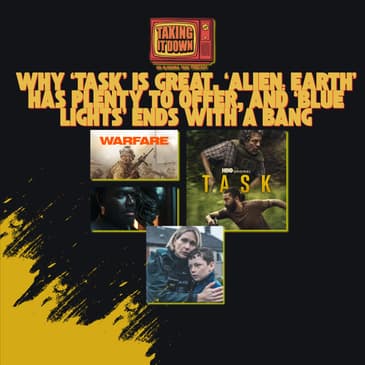





This week, Blaine begins with an overview (0:01).
Amid the current surge of compelling television offerings, the three determine which ones that they may or may not watch in the coming weeks (1:15).
They have a spoiler-free talk of how the first episode of HBO's 'Task' explores the moral complexities of its characters (11:48)while 'Alien: Earth' combines thrilling sci-fi elements with thematic questions (20:19). They also touch on general thoughts on the second season of 'Blue Lights' (22:37).
As they transition into spoiler-filled thoughts, they cover the first episode of 'Task' and its lonely men (25:40), 'Alien: Earth' and its creepy storyline (45:50), and the final two episodes of the great TV show on HBO Max 'Blue Lights' (1:00:30).
For more, visit The Alabama Take website with this link.
To sign up for the site's newsletter, visit the link here.
To help both the podcast and The Alabama Take site itself, consider making a donation of any size with the link here.
Hey, it's taking it down.
Speaker AYou know that we're the Alabama Takes TV and Streaming podcast.
Speaker ALet you know what's worth watching, give you some ideas to think about and reckon with on the spoiler side.
Speaker AAnd we'll split those in half.
Speaker ANon spoilers to begin.
Speaker ASpoilers later on this week, Adam and Donovan and I, we're gonna talk about how TV and streaming has a lot to offer these last couple of weeks and these next couple of weeks.
Speaker AWe'll also talk about the first episode of Task on hbo.
Speaker AThen we'll give some broad thoughts on Alien Earth from FX and Hulu and our last week of discussion on the Britbox and HBO Max series Blue Lights set in Northern Ireland.
Speaker AThen on spoiler side, it is definitely Task, the first two episodes of Alien Earth and all of Blue Lights for its two seasons.
Speaker AWe're glad you joined us.
Speaker AThis is a good episode.
Speaker AThis is the one to share, I think.
Speaker ALet's get Adam and Donovan in here and we'll begin.
Speaker BAlabama, take projection.
Speaker AHey, with me.
Speaker AIt's my buddy Adam.
Speaker AIt's my buddy Donovan.
Speaker AI love to see him.
Speaker AYou can't see him.
Speaker AYou can hear them every Tuesday.
Speaker ABefore we lay out our non spoiler ideas on shows, I wanted to say I'm pretty floored by the options of streaming currently.
Speaker CTell me more.
Speaker BLike, you can.
Speaker BYou can buy Hulu, you can buy Disney, you can buy hbo.
Speaker BYou can basically reinvent cable all on.
Speaker CYour own for significantly more money.
Speaker ANo, that's annoying.
Speaker AI just meant what's on it now.
Speaker AI mentioned Tim Robinson and Paul Rudd, their film friendship.
Speaker AIt's now on hbo Max on rental, and soon to be on streaming is weapons.
Speaker BI want to see that.
Speaker BI was told explicitly that because I liked Barbarian.
Speaker AMe too.
Speaker BBut I was like, I checked in with my friend, like, can I handle this in a movie theater?
Speaker BHe's like, maybe watch it at home.
Speaker BBecause I have hurt someone by accident while being startled.
Speaker AThere is no more.
Speaker AThere's not a bigger stamp of approval than maybe you should watch this at home.
Speaker BYeah.
Speaker CWell, we're right back to last week's discussion.
Speaker CRight.
Speaker COr sometime recent.
Speaker CThe.
Speaker CThe idea of jump scares me.
Speaker CDonovan not on board.
Speaker BYeah, if it's.
Speaker BIf it's judiciously used, I'll do it.
Speaker BBut I will just throw out an example of a movie that I saw a zillion trailers for.
Speaker BAnd I'm like, I can tell.
Speaker BI'll never see that.
Speaker BThat, like, Smile movie.
Speaker BYeah, no, that was advertised.
Speaker BI'm like, this is clearly just Jump Scares.
Speaker BI don't like it.
Speaker BGive me the Shining.
Speaker AI haven't even seen a trailer for Weapons.
Speaker AI've just seen a recap, and I was like, yeah, I want to see that.
Speaker BCan I share a little story about jump scares from my life this week?
Speaker AYou shit your pants?
Speaker BNo, but we've been to.
Speaker BIt's back to school time.
Speaker BSo we did a little like, quote unquote, library challenge to get people to use some of our spaces.
Speaker BAnd one of the things was they had to find a face of Pedro Pascal that we'd hidden somewhere in the library.
Speaker BAnd we took a.
Speaker AYou hid it in your pants?
Speaker BWe.
Speaker BWhat we did was we took a room, turned the light off, taped him on the little narrow thing of glass so that it looks like he's peering out at you.
Speaker BWe had students keep coming up to the front desk saying that scared the shit out of him.
Speaker BIt was great.
Speaker AHBO Max now has the film Warfare.
Speaker AThat's that real time account of soldiers starring Will Poulter, our guy Cosmo Jarvis, and even Joseph Quinn from Stranger Things in the latest Fantastic Four.
Speaker CIntrigued?
Speaker BI am too, actually.
Speaker BIt looks intense.
Speaker BIt's.
Speaker AIt's Alex Garland.
Speaker BWas he worth.
Speaker BWait, was that him too?
Speaker AYeah.
Speaker AA24, I think.
Speaker AOkay.
Speaker AI might be wrong, but it's the.
Speaker BKind of thing I'll have to watch by myself.
Speaker AYeah.
Speaker AYeah.
Speaker CSee, the thing with some movies like this, like, I was given a hard sell for Eddington over the weekend.
Speaker AMm.
Speaker CI know that it is great, but do I need to.
Speaker CAnd maybe this is some self reflection.
Speaker CI need to do that.
Speaker CI am an escapist place with my media consumption.
Speaker CBut do I.
Speaker CDo I really want to see this?
Speaker AYes, I do.
Speaker AIs it on streaming yet?
Speaker CIt's video on demand.
Speaker ASo soon for.
Speaker CFor very affordable.
Speaker ARight, Right.
Speaker AIf you wanted to do that much like weapons.
Speaker ASo soon it'll be streaming.
Speaker BThere does not seem to be a middle ground on this movie.
Speaker BLike, it's.
Speaker BYou either liked it or you thought it was like the worst trash.
Speaker BThat's.
Speaker BYou know, you thought Ari Aster was speaking out his ass.
Speaker BI'm intrigued, I guess.
Speaker CThe hard sell that I got, I'm willing to believe.
Speaker CBut it's also like, you guys are familiar with the types of fun.
Speaker CLike, one is like, it was a beautiful day and I had a great time.
Speaker CType 2 is like, it rained, but it kind of made it more fun.
Speaker CYou know, once we adapted to, we kind of went through something together, but I really wouldn't do it again.
Speaker CAnd then type 3 is like we survived the hurricane in a tent and it was great.
Speaker CI'm glad that we survived.
Speaker CI'll remember that for the rest of my life.
Speaker CBut I never want to do that again.
Speaker BLike watching Grave of the Fireflies.
Speaker CI don't need type 3 movies in my life, really.
Speaker CBut maybe I do.
Speaker CI mean, how.
Speaker CHow often have you sat down and watched a movie and said, that was great, I never want to see it ever again?
Speaker AA lot.
Speaker BI watched a couple years ago this great Belarus Belarusian film from Belarus called Come and See.
Speaker CYeah, this is probably the most famous example of this.
Speaker CRight.
Speaker BIt's fantastic.
Speaker BBut you do get to the end of it and you're like, that just wrung me.
Speaker BAnd then I made the extra mistake of being like, is that all really true?
Speaker BNever something you should ask yourself about the Nazis.
Speaker BSo I read a book called Bloodlands and to learn even more about the.
Speaker BOh, my God, Blaine, it's worse than you can imagine.
Speaker ASign me up.
Speaker BDetour.
Speaker BThe Bloodlands is the.
Speaker BWhat Timothy.
Speaker BThe scholar Timothy Snyder called the areas of Europe caught between Stalin and Hitler.
Speaker AOkay.
Speaker BAnd that's where the bulk of the fighting in the Soviet Union happened, not in Russia, although Russia has appropriated it as a nationalist conflict.
Speaker BSo you have the, the.
Speaker BThe deaths that Stalin brought in Ukraine through starvation.
Speaker BThe terror.
Speaker BAnd then you have Hitler invading and he's got the, the, you know, I think they call them Einsatzgruppen.
Speaker BThat would literally just go through the country as depicted in this film.
Speaker BThey.
Speaker BThey take out a village, they hurt everyone inside, they set a church on fire.
Speaker BAnd that's all like.
Speaker BThat's like the tame version of what happened.
Speaker AExactly.
Speaker CI've seen the Patriot.
Speaker BYeah, exactly.
Speaker BIt's.
Speaker BIt's terrifying.
Speaker AI hate to admit this.
Speaker AI'll do it.
Speaker AI'm honest and open.
Speaker ATalking about things on streaming that are new.
Speaker AI did watch a nice chunk of the two part documentary on Netflix titled AKA Charlie Sheen.
Speaker AI don't feel good.
Speaker AI don't feel good about it.
Speaker BThat's its own kind of type 3 fun.
Speaker ABut, you know, he's telling his own story and he's almost everyone involved except for his dad and his brother.
Speaker AHis famous brother.
Speaker ANo, one of his brothers actually is on there, but not Emilio.
Speaker AI don't know.
Speaker AIt's tale of rise, fall, rise again, fall again.
Speaker AHow many times can you do it?
Speaker AI don't know.
Speaker AIt's kind of interesting.
Speaker CI've only seen him hitting the media circuit for this and he was on.
Speaker CI don't know if it was good.
Speaker CMorning America.
Speaker CBut he like talked about while he was deep into drug use and then shortly after hooking up with guys.
Speaker AYeah.
Speaker CAnd then this was an unexpected part of his, you know, personality.
Speaker CAnd he, he's like, I don't really regret it.
Speaker CHe said something along those lines and it's not so much, it's like, yeah, more power to you.
Speaker CCool, live your life.
Speaker CBut just the, the idea of shocking the moms of the world with like, we're just trying to get the kids out the door to go to school.
Speaker CAnd Charlie Sheen is talking about, you know, the depths of his.
Speaker CYeah, I don't mind sexuality.
Speaker CYeah.
Speaker BFrom.
Speaker BFrom one of the co stars of Two and a Half Men.
Speaker BThis is shocking.
Speaker AMy parents used to love that show and it would make really mad that she.
Speaker AThat they liked it.
Speaker AYes, they're funny.
Speaker AAnd I was like, it's not funny.
Speaker ABut that's neither here nor there because we need to tie this into Alabama.
Speaker AWe're an Alabama tape podcast.
Speaker AYou guys remember that, that when Charlie Sheen was in the maelstrom of his drug abuse, he flew to Tuscaloosa right after the tornado.
Speaker BOh, yes, I do indeed remember because he was like, he was like, hang on, Tuscaloosa, I'm coming.
Speaker AAnd he was very nice.
Speaker BI'm coming to save you.
Speaker AAnd because of that, I think is why I watched some of this documentary.
Speaker AI was like, yeah, I remember him.
Speaker AHe seemed nice.
Speaker AHe wore the Alabama Crimson Tide cap.
Speaker ADidn't he donate quite a chunk of money or something?
Speaker CI think so.
Speaker BI believe he did.
Speaker ASo.
Speaker AHey, I don't know, it's kind of interesting.
Speaker AI mean, he's weird and a little too cocky, but.
Speaker BBut you put those ingredients together and bake it in that oven, you're probably going to get a weird dude, right?
Speaker CSure.
Speaker AAnd you know Martin Sheen's no angel.
Speaker ANo.
Speaker AWho.
Speaker CNo.
Speaker BI'm kidding.
Speaker BWe got, we got a great performance out of that in Apocalypse Now.
Speaker BBlaine.
Speaker AExactly.
Speaker AAnd they, they reference that and show that scene.
Speaker BYeah.
Speaker BAlthough I was going to say, I'm not, I'm not sure actually that the, if you, if you look at like the arc of Martin Sheen's life, it's more that like self destructive behavior is ultimately self defeating.
Speaker BSo you have to get cleaned up so you can be the president on the West Wing.
Speaker AWell, on the West Wing, yes.
Speaker AIn the United States.
Speaker BLike I have a kind of fondness for folks like Martin and it sounds like Charlie and like David Bowie.
Speaker BThe folks that were like, they were just in like crazy and then they picked themselves up.
Speaker BYou know, they got help or whatever.
Speaker BPick themselves up.
Speaker BAnd then they kept going and they kept making like art, you know, they kept doing stuff.
Speaker BThat's amazing.
Speaker BThose folks are tougher than I can ever imagine.
Speaker AHey, Platoon is great.
Speaker BPlatoon is good.
Speaker AYeah.
Speaker BOliver Stone's not.
Speaker ANo, but Platoon and Charlie Sheen in that movie.
Speaker AIt's good.
Speaker BHe's good.
Speaker BHey, Red dawn is good, Blaine.
Speaker BRed dawn is good.
Speaker AIt's okay.
Speaker AI mean, I remember it.
Speaker AIt's okay.
Speaker BGod damn it, Blaine.
Speaker AAll that plus Black Rabbit would.
Speaker AThat's a Jude Law and Justin Bateman series is going to be on Netflix.
Speaker AAnd you guys know me, oftentimes I'll.
Speaker AI totally avoid spoilers, but oftentimes you just tell me either who's in it or who's directed it and I'll make my decision there.
Speaker AJude Law.
Speaker AOkay.
Speaker AJustin Bateman.
Speaker AOkay, Black Rabbit.
Speaker ALet's find out.
Speaker AI think it.
Speaker AI think it drops this Friday.
Speaker CWe'll see.
Speaker BI'm often the same where it's like, I don't need to know the synopsis.
Speaker BI want to see the actor.
Speaker BI like Jude Law.
Speaker CI do like you Law.
Speaker AI think he can be brilliant.
Speaker CWe're just kind of overwhelmed with.
Speaker CI again have to shake my fist at the.
Speaker CThe television and film universe because like, where was all of this in August?
Speaker ALate July.
Speaker AYeah.
Speaker CAnd now there's sports to watch, huh?
Speaker BThat's.
Speaker BThat.
Speaker BThat's the issue.
Speaker BYeah, I'm.
Speaker BI watched Wake Forest play NC State Thursday night.
Speaker BYou think I've got time to watch tv?
Speaker CI don't know that Jude Law is really cracking into that lineup.
Speaker CYou know what I mean?
Speaker ABut would he watch it?
Speaker AWould he come sit on the couch with you and watch that?
Speaker CProbably not.
Speaker AHey, Mark, I tell you who would Mark Ruffalo.
Speaker CProbably down.
Speaker AYep, it's true.
Speaker AWe record on Sunday, release on Tuesday.
Speaker AAnd some of our.
Speaker AThe best television releases are on Sundays, particularly with hbo.
Speaker ADamn em to hell.
Speaker AWe will watch the releases early if you want to send them to us.
Speaker AHbo.
Speaker BI actually thought, you know, you're kind of talking about like arcs and, and you know, the way people's lives unfold.
Speaker BAnd I thought it was really kind of tragic that Mark Ruffalo, he used to be the Hulk and now he is forced to be in a Sunday night prestige HBO show.
Speaker BThat's sad.
Speaker BThat's tragic.
Speaker AThey will take all of my money if they make a lumpy Mark Ruffalo aging yet still the Hulk.
Speaker AAnd I'm kind of angry, Blaine.
Speaker CI know times are hard, but it's not that expensive to go to the movies, so you don't have to give them all of your money, buddy.
Speaker ADo you know how broke I am?
Speaker BIt's.
Speaker BIt's like the, like, what if the Hulk had heartburn and he just, like, needs a. Yeah, he needs a break for a minute.
Speaker ANonetheless, Task debuted last Sunday, which is the show created and written by Brad Inglesby, who also wrote and created the Very Great Mayor of East Town.
Speaker AWe've praised that show and talked about it week by week when it was on the.
Speaker AOn hbo.
Speaker ATask stars Mark Ruffalo.
Speaker AObviously he is not the Hulk here, though.
Speaker AWe haven't watched all of it.
Speaker AWe haven't watched all of it.
Speaker BWe're saving that for spoilers.
Speaker CThe Marvel universe is expansive.
Speaker ATom Pelfrey is on the opposite side of the law in this Philadelphia suburb set series.
Speaker AIt's a smart series thus far for a thriller, but the thrill for me comes not from who's going to be called and what they will do, but who do you sympathize with?
Speaker AAs we go through this, you can tell that's where they're going with it.
Speaker AAnd it might be a little obvious, but if you're the kind of person who enjoys not necessarily a whodunit, but you know, who did it.
Speaker ANow let's think about the morality of it all, then.
Speaker AThis is your show.
Speaker BWe've had some, I think, productive conversations about how we as viewers, you know, we do kind of naturally like line up with the point of view character.
Speaker BAnd I do like that by having two pretty antithetical point of view character.
Speaker BOr at least they're.
Speaker BThat's not true.
Speaker BThey're competing for different things.
Speaker BRight.
Speaker BSo it is that kind of great.
Speaker BOkay.
Speaker BThey're both the protagonist.
Speaker AWho.
Speaker BWho am I rooting for here?
Speaker AYeah.
Speaker BOr at least enough to think and reflect about that.
Speaker AWas the pilot too familiar ground for you?
Speaker ADid you guys like it for Task?
Speaker CI was going to say that it.
Speaker CIn a way, it feels like a throwback to the anti hero thing that so dominated television there for a few years and still does.
Speaker CReally?
Speaker AThe.
Speaker CAre the bad guys really that bad or the, you know, this is super dark kind of.
Speaker CIt did feel a bit like.
Speaker CLike we've been here before.
Speaker CAnd I, I'm sure I trust the writers and actors in this enough that I'm going to keep watching and I enjoyed it, you know, but it did feel like we weren't really seeing anything new.
Speaker AIf you're making the comparison to, say, the Sopranos are Breaking Bad, the anti hero there or Mad Men.
Speaker ALike they were such point of view characters that even if that they were bad, you were still pulling for them.
Speaker AHere it's divided right down the middle between Mark Ruffalo's character and Tom Pelfrey and I think that makes a difference.
Speaker CYeah.
Speaker CAnd I think there were some, some good reviews that talked about family and the, the role of, you know, in a time when like masculinity is very much in the national international conversation, what that means, I think it's asking a lot of questions there in a way to, to do something like Mayor of East Town did and then to pivot back to a more conventional story is.
Speaker CIs interesting.
Speaker CYou know, so ultimately it seems like it's going to be a family thing, which is a funny.
Speaker AYeah.
Speaker CWith this much non spoilery there.
Speaker CThere are weapons and drugs.
Speaker CYou know, just say, oh, a real.
Speaker AFamily story and a task force.
Speaker CYeah.
Speaker ATom Pelfrey lifted the Netflix series Iron Fists.
Speaker AYou know, that was the waning days of.
Speaker BWas he in that?
Speaker BI heard it wasn't good.
Speaker BIs he?
Speaker AOh, it's not good at all.
Speaker ABut he was good in it.
Speaker AIt's great that he gets to do serious or maybe well written work here.
Speaker AHe was also in the Amazon series Outer Range, which wasn't bad.
Speaker AHe shined there even in scenes with Josh Brolin.
Speaker BYeah, I, I do not think I've seen him and stuff.
Speaker AOh, he's good.
Speaker BHe just seemed really, he seemed really good to me.
Speaker BWell, the beard.
Speaker BWell, yeah, I didn't.
Speaker BI was looking at other things he done and by and large, I don't think I've seen him.
Speaker AHe's been clean shaven one thing or the other in everything I've seen him.
Speaker ABut yeah, Adam, there's this epidemic of male loneliness being reported, covered in media, discussed in all kinds of podcasts, from the positive and the negative side, from the manosphere to the brocast, whatever you want to call them.
Speaker AOne side of the coin, you got your, I guess, Jordan Petersons and the other side is the Jonathan Hates.
Speaker ABut this show seems to be facing it head on and timely.
Speaker CYeah, just the.
Speaker CIn, in the, in the swirling world of like, you know, are you an alpha, are you a whatever, are you beta?
Speaker CRight.
Speaker CI don't, I don't even engage with that stuff to know like the names of who's talking about it because it seems so ridiculous.
Speaker CBut I guess what's funny here, I don't know if we know how deep into spoilers we want to get but you know, there are two people that are still very much concerned with the people around them, which is going to be an interesting collision.
Speaker CI think it adds to that.
Speaker CNo one is just purely ruthless.
Speaker AYes.
Speaker CDudes doing dude stuff.
Speaker AYeah.
Speaker CAbout it.
Speaker CThere's all.
Speaker CThere seems to be a reason.
Speaker CThere seems to be empathy and responsibility.
Speaker CI know empathy is a funny word to use this week, but, you know, and so to see how that plays out and a good guy versus bad guy scenario will be interesting.
Speaker AOh, yeah.
Speaker AYeah.
Speaker AAs soon as I was halfway through the episode, I worried the writers would be criticized as the show is really man heavy.
Speaker ABut that's the point of it now.
Speaker AThese are men without women, and we're seeing maybe the detriment of those situations.
Speaker AThese are weak men.
Speaker AThey're disguising their weakness.
Speaker AOne could argue the two primaries are.
Speaker AOne's doing a little better than the other by covering up fears and loneliness and existentialism.
Speaker ABut they're not strong, silent types.
Speaker AWell, silent maybe, but they're not strong.
Speaker ANo.
Speaker CAnd they're also not.
Speaker CThey're not shown to be okay with the lonely male thing, you know, like whether like the.
Speaker CThe ghost of the.
Speaker CThe women who are not in their lives is very much a character, you know, and they're even actively seeking it out and having like, in one case, like fairly healthy conversations with their.
Speaker CWith their guy friend about what to do about it.
Speaker AYeah.
Speaker AIt too has an aspect of the Apple TV show Dope Thief in it in that the criminals are casing and raiding drug houses for money.
Speaker ASo I can see that people would be like, well, we've seen this recently.
Speaker AWell, I don't think quite like this.
Speaker AAnd assuming I've got a correct read on it, intentional or not, there's this motif in the series and it makes for a good crime drama.
Speaker AIt's not just a catch the bad guy or who done it.
Speaker AIt's exploring some issues that are prevalent.
Speaker AAnd I. I think it's pretty good.
Speaker BI'd give this one a thumbs up and say I'm gonna watch more.
Speaker BIt tickled me personally that I made that joke about like, it's gonna be like God is dead.
Speaker BAnd then he used to be a priest.
Speaker BHis priest friend shows up.
Speaker AI don't know if you remember last week I said he was a philosopher.
Speaker AWell, it turned out he used to be a philosopher.
Speaker BPhilosophy student, majored in college.
Speaker BYeah.
Speaker ASo I was half right.
Speaker BThe other pleasure of this is of course the same as mayor of Zeastown.
Speaker BAnd that's hearing people say Wooder Ice water.
Speaker AMy wife pointed out they have interesting accents.
Speaker AWell, we're finally getting into Alien Earth on the spoiler side of things soon in a little bit.
Speaker AThat's the Noah Hawley led production of a spaceship that hits future Earth and all hell breaks loose.
Speaker AUntil we get to the spoiler side of the podcast, though.
Speaker ADonovan.
Speaker AI'm going to be the experimental audience for this series as I've never seen an Alien related movie.
Speaker BYes.
Speaker BYeah, you're coming in pretty, pretty cold.
Speaker AYeah.
Speaker AThere's a lot to like about this show, but I think there is a lot for viewers to look at sideways.
Speaker BWhat do you mean when you say look at sideways, Blaine?
Speaker AYeah, I think people, regular viewers might critique it or think badly about it.
Speaker ANot me.
Speaker ABut it is so packed with thematic ideas, so much so that the characters will speak them aloud every now and again.
Speaker AAnd your mileage may vary on that kind of series.
Speaker BYeah, I think that's a Noah Hawley thing too.
Speaker BI think he does that in Fargo as well.
Speaker AYeah, he does it.
Speaker BDid it.
Speaker BDid it in Legion.
Speaker AI don't think he does it as blatantly as he does here.
Speaker AHe did it in Fargo for sure.
Speaker BThat's interesting because I actually thought.
Speaker BI had the opposite experience where I thought, oh, he's.
Speaker BHe's hiding it a little bit more in his characters than he has in some of Fargo.
Speaker BFor instance.
Speaker AWell, I'm only two episodes deep.
Speaker BYou're in the.
Speaker BThose are.
Speaker BThose are the cinematic movie episodes.
Speaker AOh, they were anyway.
Speaker AYes.
Speaker AAnd.
Speaker AExactly.
Speaker AIf you like action, gore, cerebral storytelling, it's for you.
Speaker AEven if you're only slightly interested in science fiction or the Alien franchise, there.
Speaker BWas already this kind of good stuff in the background of the Alien franchise that Holly was able to take and kind of repurpose, you know, everything.
Speaker BThey're in the midst of, like, corporate feudalism.
Speaker AYeah.
Speaker BYou know, you.
Speaker BYou was.
Speaker BYou.
Speaker BYou are.
Speaker BYou know, we even have the joke where like the, the.
Speaker BWe have the terrible trillionaire who says, oh, rescue survivors by income level, you know, and.
Speaker AYeah.
Speaker BAnd then we've got.
Speaker BI mean, like, what is the self territory.
Speaker AYeah.
Speaker AWho.
Speaker BWho are these people who think that they're children?
Speaker AYep.
Speaker BAlso, Timothy Oliphant's great.
Speaker AYes.
Speaker AAnd he's a.
Speaker AOne of the major actors in the show.
Speaker AIt's our last week of discussion on the Brit Box and HBO Max series Blue Lights, set in Northern Ireland, following several cops in their attempt to, you know, do their job, basically.
Speaker AWhich is if there's a crime going on, you go to it.
Speaker AAnd you try to figure out what's up in the spoiler section.
Speaker AWe'll discuss the details of the final two episodes of season two, which is all that's aired, but two more seasons are promised.
Speaker ADid the second season live up to the first one, satisfy you with its ending, its resolutions?
Speaker BYou know, honestly, for the second, and I felt this a little bit with the first, it was good.
Speaker BI was left wondering, what would they do if they had two more episodes?
Speaker BYeah, that was my.
Speaker BWhich is not a negative review, by the way, for this show.
Speaker BI believe it was good.
Speaker BBut I, I felt like, man, if they'd had like two more episodes, I wonder what that would have been like.
Speaker AYeah, if you rap early rather than string it along, I think that's better.
Speaker ABut there were some moments where agreed.
Speaker AThere were some agreed scenes, some plot lines where I was thinking, oh, that's a little sudden.
Speaker BI, I tend to agree with you there, Blaine.
Speaker BI think that the worst sin is to, is to stretch it out.
Speaker BLike those horrible, you know, we, we saw this with.
Speaker BYou already mentioned Iron Fist.
Speaker BLike those Netflix Marvel shows were terrible at that.
Speaker BBut there was just, there was stuff here that I found, like, rich and interesting.
Speaker BSo it was more of a, like, I'd like to see a little bit more about that.
Speaker BAnd, and I agree with you too, Blaine.
Speaker BLike, some of it felt a little abrupt, but I think that's kind of a, you know, it's like, okay, you're interesting me.
Speaker BI'd like to see what, what more you could develop with this as a.
Speaker BIs a more positive review.
Speaker BAnd I, and I don't think it's a vice to, to, to wrap it up in six either.
Speaker ANo.
Speaker ABut good news is we're getting a season three and four.
Speaker BI'll be watching it, man.
Speaker AAnd so come back to some of this stuff.
Speaker BYeah, for sure.
Speaker AWe're going to take a break right here.
Speaker AAnd that will divide our show in two.
Speaker AOn the other side of the music and the call to action is our spoilers.
Speaker BSam.
Speaker AOkay, we're back.
Speaker AThe first episode of the Sunday HBO crime drama Task debuted last week, and it's title crossings.
Speaker AWe'll discuss that in detail with spoilers, so use timestamps to skip ahead to the section on Alien Earth, if that's where you want to go.
Speaker AOr Blue Lights.
Speaker AI'm going to start with some praise.
Speaker AI thought it was great.
Speaker AI said so much in the non spoiler part of our podcast.
Speaker ABut in the opening Task does exactly what we, the three of us have asked Television to do and that's to show and don't tell, you know, just some good visual storytelling.
Speaker AAs Pelfree's character, Robbie.
Speaker AAnd this was maybe the.
Speaker AOne of the most powerful visual storytelling I had seen in a long time in a show.
Speaker AAll he does is in the early morning dark is he moves his young son from one room to the other without waking him.
Speaker AAnd that moved me heavy, heavily.
Speaker AAnd that signaled to me as a viewer that he, yeah, he's going to be the baddie.
Speaker ABut he legitimately loves his family.
Speaker AThere's just something about that visual that's resonant and says way more than the actual action.
Speaker CI thought all of the familial stuff on that side was so well done.
Speaker CDid it in a show don't tell kind of way.
Speaker CThat scene you're talking about the rhythms of when he comes back from work and it's dinner time and just all of that was so like, you didn't have to say a lot.
Speaker CYou know, it's by.
Speaker CBy clearly showing this.
Speaker CThis is just a normal day in this guy's life, you know, and it's.
Speaker CIt's as close to like a normal routine as you can get.
Speaker AYes.
Speaker AHis niece, who's caring for the family for the majority of the time, she didn't have to say, well, we don't have any money in the bank.
Speaker CRight.
Speaker AYou knew that.
Speaker CRight.
Speaker AAnd.
Speaker ABut.
Speaker ABut Mark Ruffalo's character, Tom, has some nice visual storytelling.
Speaker ATo begin, he's shown struggling to pray.
Speaker AHe drinks a 32 ounce cup of vodka on the daily and he appears out of shape.
Speaker ANot the Mark Ruffalo of mcu.
Speaker CNo.
Speaker CAnd he's.
Speaker CYou know, when you have seen the warm and fuzzies of the.
Speaker CThe criminals family life and then you see a big nice house that feels very empty in most of the shots.
Speaker CYeah.
Speaker CThat was also very good storytelling.
Speaker CAnd just the.
Speaker CI don't know, maybe it's because I have had to go to them and be on both sides of it, but the clinical nature of his, like, come to the job fair, you know, him stacking all of the.
Speaker CYou don't have to know that this is a guy whose career has gone sideways.
Speaker CYou don't have to talk about it like something happened.
Speaker CBut the guy sorting the pamphlets and putting them in a little plastic stand.
Speaker CNobody wants to be that guy.
Speaker AFor the FBI.
Speaker CFor the FBI.
Speaker AIt's not like he's doing it for Dollar Tree.
Speaker CRight.
Speaker AWhich would be, I don't know, another story.
Speaker BBecause of that storytelling, I felt that by the end of the episode, all the questions I had were either inconsequential.
Speaker BFor example, they don't right away say that Maeve is his niece.
Speaker BSo I'm like, could be an older sister or younger sister of his.
Speaker BAnd the.
Speaker BSo it doesn't matter ultimately.
Speaker BAnd it's addressed and it's not.
Speaker BAnd then the.
Speaker BThe big questions, right?
Speaker BLike, what happened in these families?
Speaker BAnd I thought that was just great because, you know, like, you know, like you said, you know exactly who these people are, but you don't know what happened to them.
Speaker CAnd they're in a time that's not settled.
Speaker CYou know, that you see the conflict with the niece over the house and who's.
Speaker CWho truly has ownership of a dead man's things, essentially indicating that they're very much in the unsettled stages of grief on that.
Speaker CAnd then on the other side, you have a father trying to coach his daughter through giving a statement on something that the brother did in the family.
Speaker CAll that's still very vague.
Speaker CRight.
Speaker CI don't think I missed anything.
Speaker CBut all we really know is that something happened in the family unit.
Speaker BThere's an extra kid in a photograph he looks at right there.
Speaker BThat's about all we know.
Speaker BThat's about all we know.
Speaker AWell, Tom takes a suit of clothes to a prison environment, and they ask if he wants to stick around for visitation, and he says no.
Speaker CWell, we know where one son is for sure.
Speaker AThat's right.
Speaker BYeah.
Speaker BYes, for sure.
Speaker ASo are these over complicated characters?
Speaker AYou know, should we have at least one person who has it together a little?
Speaker CI mean, the daughter.
Speaker CThe daughter's doing pretty well.
Speaker AYeah.
Speaker BShe works at Rita's.
Speaker AYeah.
Speaker AThe layers of issues from these people are troubles on top of troubles.
Speaker ATom can't pray.
Speaker AHe's quit the priesthood.
Speaker AHe doesn't want to be anything more than an FBI worker at a desk or at a job fair.
Speaker AMaybe his son's in jail.
Speaker AHis daughter's distant, needs him to say something at her brother's hearing.
Speaker AOr she needs to say something at her brother's hearing.
Speaker ATom's got no wife to help him out.
Speaker AHe's aging.
Speaker AHe's out of shape.
Speaker AThat's just Tom went and gotten to Robbie.
Speaker BThis is a show that dares to ask, is God dead?
Speaker CI really appreciated the Thomas Merton shout out.
Speaker BI did too.
Speaker CI like as a person he's no longer interested in.
Speaker BThat was good.
Speaker BWasn't felt like a good tie in with obviously it was a Richard Rohr reference there for the friend that comes in, it's like, oh, yeah, yeah, he's done.
Speaker AYeah, well, yeah.
Speaker ABrings me to.
Speaker AOne of my favorite scenes is when he taps the desk, the table, and says, is God in this table?
Speaker AAnd he says, are you there?
Speaker AHe must be on bathroom break.
Speaker BYeah.
Speaker BI am curious if they're going to keep up this idea of, like, imminence, of.
Speaker BI don't want to, like, narrow it down to one religion, but like, imminence of the divine, basically, like in.
Speaker BIn the dirt.
Speaker BBecause that's where that table is, that it's in the dirt of our lives.
Speaker BAnd are we gonna.
Speaker BIs this something we're gonna see more of?
Speaker BYou know, is.
Speaker BIs it.
Speaker BDoes the divine as the friend.
Speaker BThe friend who's a priest, Father Daniel proposes, Does the divine in fact extend so far as to be in Robbie's family or in the actions with two men who are doing things that are probably not very moral or ethical?
Speaker BI'm curious.
Speaker BIt may not.
Speaker BThat may just be my own thought, but I thought that was an interesting question to bring in.
Speaker AIt is the withholding the show does points you in the right directions.
Speaker AI think it wants to show you, you know, family, the divine.
Speaker AWhat role does man and woman play in modern families?
Speaker AThis series also relied on repeated images of birds and sometimes nature as a whole.
Speaker AAs Robbie and his friends go swimming, you know, like, give us some freedom, nature, carefree feelings, which is what a lot of these people are lacking or wish to have.
Speaker CThat is a funny moment when, you know, they've shown to kind of live out in the country, you know, on land, and they go swimming.
Speaker CAnd it's like.
Speaker CIt made me think.
Speaker CA lot of people think that you have to attain money to be able to afford those things.
Speaker CAnd it's like both sides of the bell curve are enjoying nature more profoundly than maybe the folks stuck in the middle.
Speaker CObviously, he is changing his financial situation a few nights a week, it seems like.
Speaker CBut yeah, that scene, I mean, there was a few cues that, like, this little gang is not going to make it out of this episode.
Speaker CRight.
Speaker CLike, no one can have that good a time swimming and everybody make it out alive.
Speaker CThat was a really well done scene.
Speaker CI mean, you're immediately taken there, that summer green, that part of the country.
Speaker CYou're like, oh, yeah, we're just having a great day.
Speaker AAnd another thing that task does, and this is super simple, is that when they don those masks, those things are kind of scary.
Speaker CYeah.
Speaker AAnd when you get your quote unquote bad guys who look scary, I like that in a show.
Speaker CAgreed.
Speaker AAnd I immediately loved the Robbie character.
Speaker ADespite his wrongdoings.
Speaker AHe's just got some relatable motives.
Speaker CIt's also using masks like that works in like the classic way that a mask is supposed to work.
Speaker CLike it separates the individual from the image that they're projecting and it allows them to do.
Speaker CAnd I know this is like crime 101, but as opposed to just like pulling like a hood over your face or something like that and running in like, this has like some theater to it.
Speaker AI would dare say that there's some specificity to the mask they picked for each character.
Speaker BThe skull, the devil, and the werewolf and the wolf man.
Speaker BYeah, I would agree with you.
Speaker AI've been wrong.
Speaker ABy TV once again.
Speaker AI've always assumed a task force was very high level here.
Speaker AIt's like treated low man on totem pole.
Speaker BWell, this is the era of budget cuts.
Speaker CYeah, but that was another interesting thing about the task force is like, you get the impression that for some of them, this is like a.
Speaker CA big deal.
Speaker CI mean, I kind of got the impression like, oh, we're working with the FBI.
Speaker CI have my little FBI hat.
Speaker CMaybe even if this specific exercise is not a big deal, like, it's still like, okay on the resume, you know, like, and clearly for our main guy, he's.
Speaker CHe's stepping down to run this thing, but.
Speaker BYeah.
Speaker CIs everyone meeting at the same space in their career?
Speaker CI'm not sure how we're supposed to read that quite yet.
Speaker AAdam, did you feel related to the Ruffalo character?
Speaker AHe grows tomatoes connected to Earth, drinking 32 ounce vodka.
Speaker CDeeply depressed.
Speaker BI was thinking, you know, Adam.
Speaker BAdam is a noted bird watcher.
Speaker BOne bird in particular.
Speaker BHe's got to watch out for that mockingbird.
Speaker CThe only mockingbird.
Speaker AThat's right.
Speaker CI did think the montage of him cleaning up the house that they're going to use for the task force.
Speaker CI thought, man, I could hire this guy.
Speaker AWell, I thought that, man, any job is hard work.
Speaker AUsually what you see on these kinds of shows is him opening the files and peering over and creating the cork board.
Speaker CAnd I just kept thinking over and over again, they don't have somebody that does this for them.
Speaker CCan agent go out.
Speaker AAnd I appreciate a series demonstrating Ruffalo having to fix a house he's been given for the task force to convenience.
Speaker CIt's also a real dad flex.
Speaker CRight?
Speaker CLike, this guy's not a casual dad.
Speaker CThis is a guy who, you give him an overgrown house, he's not only going to pull the weeds off.
Speaker CBut you know, you got some, some walls that need patching.
Speaker CHe can figure it out.
Speaker AHe's making an attempt at transcendentalism, but he just can't break free from the drinking.
Speaker AMaybe because his son's in prisons or some of the worries or lack of wife.
Speaker CStraight to the vodka too.
Speaker AI mean, 32 ounce, that's a lot of vodka.
Speaker AI discussed in the introduction that these are lonely men, but I think everybody in Robbie's house is lonely, including his daughter and the 21 year old niece who's tasked to, to watch over the house while Robbie does his job as a garbage truck driver.
Speaker AShe tells her cousin she's going on a date with a guy who's a six.
Speaker ABut it beats being alone and stuck in a house with fart jokes.
Speaker ABut she's lonely too, man, the way.
Speaker CThat they set that character up.
Speaker CI don't know if you guys also at 21, 22, thought like, well, I'm, I really don't know what the hell's going on.
Speaker CYou're off the leash, so to speak, but you also don't really have anywhere.
Speaker CIt's like, I don't understand how this works.
Speaker CNow what do I do?
Speaker CIt's hard to see how to put one foot in front of the other.
Speaker CAnd her just like complete frustration with that when it bubbles over in a few different ways is.
Speaker CI don't know.
Speaker CI thought that was well done and characterized that, that kind of moment in life so well, obviously to the extreme of like, I'm caring for children that are not mine.
Speaker CI'm stuck in with.
Speaker CWith the ghost of her dad.
Speaker CRight.
Speaker CAnd his brother who's like trying to edge in on the.
Speaker CI don't know, it all just seems so, you know, they work backwards from showing like her putting her best effort into the dinner.
Speaker AYeah.
Speaker CBecause she got the recipe online or whatever.
Speaker CAnd it's like trying to spruce things up a little bit.
Speaker AShe tries so hard.
Speaker ABut that food did not look edible.
Speaker CNo, it didn't.
Speaker CAnd even the little things like him getting on his son, like, we have to be nice.
Speaker CI'm going to shoot somebody later this episode.
Speaker CBut you still have to be nice to the person who cooked your dinner.
Speaker AYeah.
Speaker BI liked it.
Speaker BAs a counterpoint to kind of like that family can be like this deep wellspring of love as we see when he, Robbie brings his son into the bed without, without waking him.
Speaker BBut also like sometimes family is the people you're stuck with.
Speaker AYeah.
Speaker BAnd she's feeling stuck, you know, she is.
Speaker AThe task force itself is going to be our other family, I'm willing to bet.
Speaker BAbsolutely.
Speaker AAnd it's just another example of everything going to.
Speaker AThey're green or weird or headaches.
Speaker ALike the lady who doesn't know how phone etiquette at the job.
Speaker AShe shows up having not read the brief and reminds me all too much of that person who shows up in.
Speaker AYou're like, why didn't you read the email?
Speaker AIf you would have just read the email would get started right now.
Speaker CThis project nightmare.
Speaker AYeah.
Speaker AGroup project nightmare 101.
Speaker AYep.
Speaker AAnd I mean all the storylines are pretty pitiful.
Speaker AThat younger daughter of Robbie's who she needs that motherly affection yet she overhears her 21 year old niece might move and she's like, you know, I don't want you to move.
Speaker AThe young boy, he needs someone.
Speaker AHe needs a.
Speaker AHe needs a man.
Speaker AThey're living in poverty.
Speaker AEveryone's lonely, tired or both.
Speaker BFamily can be very isolating especially if you're somebody who has maybe a clannish idea of family.
Speaker BYou know, these are the people who are the most in.
Speaker BAnd we're distinct from everybody else because you are kind of.
Speaker BI mean.
Speaker BAnd maybe we'll see more of this but they seem lonely as a unit.
Speaker BYou know, where are the friends?
Speaker BThere's Uncle Trash.
Speaker BWhere are the kids?
Speaker BFriends.
Speaker BWho do they have?
Speaker BYou know what I mean?
Speaker AYeah.
Speaker AYeah.
Speaker CAnd we did just get a one episode glimpse.
Speaker BOh for sure.
Speaker CI did wonder.
Speaker CThey.
Speaker BThat was just the impression.
Speaker CThey felt very isolated there.
Speaker BFor sure.
Speaker CIt's like are they going to school?
Speaker CDo they have.
Speaker BYeah, that was.
Speaker CThey have classmates.
Speaker CYeah.
Speaker CBut at the same time when the niece goes out and brings the boy back, there was almost like kind of an endearing moment of like he jumps into the closet to try not to embarrass.
Speaker CAnd what starts is like.
Speaker CLike he's.
Speaker CHe's trying to.
Speaker CI'm sorry, I couldn't help but think of that the Dave Chappelle when keeping it real goes wrong.
Speaker CWhere he has to go live with his grandmother and she's trying to get her swerve on too.
Speaker AYeah.
Speaker CBut it's like he's trying so hard to stay out of her way and then finally just like I'm sorry, I'm leaving, I'm leaving.
Speaker CAnd the guy.
Speaker CAnd obviously it goes to shit.
Speaker CAnd that's when the fight pops off.
Speaker CBut he was even trying to be.
Speaker BA good guy then all he was doing was stealing some reefer.
Speaker BHe was trying to get up there.
Speaker BHe was Gonna roll it up and smoke it like a cigarette.
Speaker ACooking food here works really well.
Speaker ATom's daughter serves him that.
Speaker AWhat is it?
Speaker AIs it.
Speaker AIt's not ice cream.
Speaker AWhat do you call it?
Speaker BIt's Italian ice.
Speaker AItalian ice.
Speaker BBeth was very.
Speaker BMy wife grew up in Pennsylvania, so she was very tickled to see Arenas, which was a fixture of her hometown.
Speaker AGotcha.
Speaker BSo it's Italian ice.
Speaker BWater is Italian ice.
Speaker CAnd he got just an ungodly amount of it.
Speaker CGood Lord.
Speaker AYeah.
Speaker ABut, you know, other than that, Tom only intakes vodka.
Speaker AHe delivers tomatoes.
Speaker ARobbie's niece Maeve doesn't cook.
Speaker AWell, we talked about that, how it's a strange relationship.
Speaker AAnd then the cooking being bad is a hint of that.
Speaker ABut let's get to the real heartbreak here.
Speaker ARobbie carries the kidnapped kid in the same manner that he kind of moves his own son from one bed to another.
Speaker AIt's.
Speaker AIt's.
Speaker AThere's a similar book.
Speaker CEnds of the episode.
Speaker CYeah.
Speaker ASo they go to bust into the most recent drug house to rob them.
Speaker AIt goes to hell.
Speaker AAnd they didn't know there was a kid there, and they have to take the kid with them, or Robbie feels as though that's the right thing to.
Speaker BDo as soon as they took their masks off.
Speaker BRight.
Speaker BYou know that it's not over.
Speaker AYeah.
Speaker AIt's a.
Speaker AIt's a series with this first episode sets up that kids are important here in this world.
Speaker AIn this series, you know, it ends with the kidnapped child from the drug house.
Speaker AI'd be curious to know if Tom's son is the reason the wife's not around.
Speaker AShe had no desire to see him in prison or something.
Speaker AI was kind of shocked to see the plot move forward as fast as it did in the last 15 minutes with the death of one of Robbie's crew.
Speaker BOh, I figured he was marked for death.
Speaker CI mean, between the swimming and saying, oh, yeah, one more job, and we can get the down payment on the.
Speaker CThe wedding.
Speaker CIt's like, oh, man, McBain.
Speaker CEnjoy your screen.
Speaker AFirst, though.
Speaker ADon't you try to drag the body away from the crime scene.
Speaker AI get you can't clean the blood, but do you just leave the body there?
Speaker AOr is that.
Speaker AIs that the point?
Speaker AYou leave it there so that there's somebody to blame for the killings and the robbery.
Speaker AIt's just the one guy.
Speaker CYeah.
Speaker CYeah.
Speaker CI mean, you almost wonder if, like, the calculus there is.
Speaker CWe're already in, like, a hell house, you know?
Speaker CLike, this is where bad things happen.
Speaker CIf you're.
Speaker CThey're not as Breaking into, like, a suburban home, you know, so, like, that bad people would shoot each other as maybe less of a blip on the radar than, like, finding a body in the woods.
Speaker BYes.
Speaker BI get the sense that these folk, Robbie and his friends don't.
Speaker BThey don't have a big contingency plan for if things go wrong based off of, like, everything I know is from TV and movies.
Speaker BRight.
Speaker BBut, like, they go up to peach boy, right?
Speaker BIt's.
Speaker BIt's.
Speaker BIt's middle of the day.
Speaker BThey're not make.
Speaker BYou know, they don't care if anyone's listening in.
Speaker BThey say, hey, we're, you know, we're gonna tonight.
Speaker BYou know what I mean?
Speaker BLike, they just seem kind of amateurish, like they didn't know what to do.
Speaker CAlthough they.
Speaker CThey clear a house pretty well to start out.
Speaker BThey do.
Speaker BThey for and for.
Speaker BThey are seem to be expert shots since they all hit someone with a firearm in the midst of confusion and dark without hitting their friends in one shot.
Speaker AYeah, they've done this before.
Speaker CThey have fired weapons.
Speaker BCertainly they have, but that was just my impression is that, like, these guys are not like hardened criminals.
Speaker BThey're not like, what's good?
Speaker BWhat are we gonna do when one of us inevitably dies?
Speaker BYou know?
Speaker ARight.
Speaker CYou do wonder.
Speaker CI mean, is.
Speaker CY'.
Speaker CAll, correct me if I'm wrong, but he gets a text from someone, right, Saying, like, this is the time to move on.
Speaker CThis one who texted him?
Speaker BYeah.
Speaker BYeah.
Speaker AThey got someone else involved or helping.
Speaker AThere's a lot, a lot to look forward to in this show.
Speaker BDo we like our East Town shout out.
Speaker BAnyone else catch it?
Speaker BI felt very pleased if you.
Speaker BIn the recruiter fair, where the job fair that Mark Ruffalo is at when he's testing his binoculars, he looks at a police officer right behind it on the banner.
Speaker BYou can see that part of the website says easttownpd.org so presumably the police officers from Easttown.
Speaker BSo.
Speaker BI thought that was cute.
Speaker CVery good.
Speaker ASame universe as mayor of Easttown.
Speaker BYeah.
Speaker BSo there you go.
Speaker BIt's the expand.
Speaker ASo a lot to look forward to with tasks.
Speaker ABut for now, as one begins, one ends.
Speaker AAlien Earth is airing on FX and Hulu.
Speaker AAnd here are our more detailed ideas about the series thus far.
Speaker AWell, not thus far.
Speaker AI'd say only the first two episodes.
Speaker AWe'll be spoiling those.
Speaker AAnd then the rest of the series next week as it wraps itself.
Speaker AFirst season Donovan.
Speaker ADoes it have a second season plan?
Speaker BI don't think anything's been confirmed yet.
Speaker AOkay.
Speaker BI mean, it Seems like it will need a second season, but we'll see how.
Speaker BI'm sure.
Speaker BIt was not cheap to make, so.
Speaker AIt looked very expensive to make.
Speaker BYes.
Speaker AMy impression of this first episode titled Neverland, was that it held me at a remove.
Speaker AAnd I couldn't distinguish if that was on purpose because a lot of these characters are not thoroughly human, but cyborg synths and hybrids.
Speaker AAnd just for clarity, if anybody can't remember enhanced humans or cyborgs, artificially intelligent beings or synths, and synths that have human consciousness put into them are hybrids, and all are.
Speaker AThese are just this attempt at immortality.
Speaker ASo I also.
Speaker AI couldn't tell if that was the remove I was feeling, but I couldn't pinpoint if the arm's length of feeling was from this being my first encounter with the franchise.
Speaker AI did often ask myself if I was missing something.
Speaker BNo, I don't think he did.
Speaker BI think I felt the same way, although I kind of.
Speaker BI kind of liked it.
Speaker BYou know, we're.
Speaker BWe're getting a skewed view of.
Speaker BHonestly, what I. I think was kind of part of it was like, we're on like, Dr. Moreau's island here, right?
Speaker BLike this.
Speaker BThis is Dr. Frankenstein stuff, right?
Speaker BYou know, it was like, perhaps we are making monsters here there.
Speaker AOkay.
Speaker ASo I said that I felt as episode one, I felt like it held me at arm's length.
Speaker AIt felt distant.
Speaker AIt felt a little cold.
Speaker AI watched it again.
Speaker BOh, yeah, I did.
Speaker AHuh.
Speaker ABecause I watched it the first time really late at night, and I was like, was that.
Speaker AYou know, was I tired?
Speaker AWas that it?
Speaker BYeah.
Speaker AI still felt the remove, but I also noted doubly there's a lot to enjoy here.
Speaker AThe aesthetic of the show is eye catching, to say the least.
Speaker AThe way it tells its story by glimpses into the past and perhaps future in short cutaways.
Speaker AI mean, they're.
Speaker AThey're not even short cutaways.
Speaker AThey're almost like inserts, glitches on of the screen.
Speaker AAnd also has this way.
Speaker AAnd maybe the original film did this.
Speaker AYou can tell me.
Speaker AIt also has this way of slow fading from one scene to another that looks both retro and gives you a sense of matters lingering or time moving at different speed here.
Speaker BI think that's more for this.
Speaker BThat's Holly.
Speaker AReally?
Speaker AYeah, it's.
Speaker AIt's almost like time moves differently in our future.
Speaker BI. I think I said this first time I brought up.
Speaker BI will probably have trouble talking critically about it just because there much stuff that just thrilled me in this first episode and that it also seemed like it's able to be using science fiction to talk about, you know, like, really, like really real things.
Speaker BI will say, I do want to shout it out.
Speaker BThe set designs, the design elements are excellent because, you know, obviously Alien, the first alien is 1978.
Speaker B79, something like that.
Speaker A78.
Speaker B78.
Speaker BSo they're, they.
Speaker BThey're doing such an excellent job of doing, like, this is the futuristic technology we imagined in the 70s.
Speaker BYeah, this looks fantastic.
Speaker AAnd the scroll on the screen to explain hybrids in the year and the city you're in, it felt straight from, you know, 79, early 80s.
Speaker AI loved it.
Speaker BI loved it.
Speaker BThat being said, I felt that it instantly fell.
Speaker BI felt like it instantly fell into its own Groo.
Speaker BThe kids with Boy Cavalier with the mad science that he's doing on his island.
Speaker AOkay, so here's my question about his entire collection of scenes.
Speaker ADo you need the blatant Peter Pan references or should that have been implied and work in that manner?
Speaker AWhat they.
Speaker AI kind of do is have him read from the book show the cartoon.
Speaker AWe, the young lady who moves to a new healthy synthetic body, she chooses the name Wendy.
Speaker AIt's very overt.
Speaker BObviously they are spending their Disney money here.
Speaker BWe've got a little corporate.
Speaker BI mean, honestly, we've got a little corporate synergy going on.
Speaker BRight?
Speaker BIt's the Disney version of Peter Pan that they see actually every movie that.
Speaker BThis is a complete aside, but like every movie this child has ever seen is like 150 years old at this point.
Speaker BYeah, yeah.
Speaker AModern art is muck, right?
Speaker BAnd I.
Speaker BThat's just.
Speaker BI mean, that's not a real quibble or anything.
Speaker BI just.
Speaker BIt's just funny.
Speaker BI actually thought that there are good real world parallels to a trillionaire who loves a book.
Speaker BBut how does he understand it?
Speaker AHis interpretation is completely off.
Speaker ARight.
Speaker BOr we'll find out.
Speaker BAnd I'll give you.
Speaker BI'll give you.
Speaker BWell, I mean, I'll give you a real world example of this.
Speaker BPeter Thiel has a small company called.
Speaker BHas a company called Palantir, which comes from the Lord of the Rings novels.
Speaker BIn my opinion, and many people who studied it.
Speaker BTolkien would be like, what are you doing?
Speaker AOh, for sure.
Speaker BBut it was obviously very meaningful to him enough to name it.
Speaker BSame thing with like the story of Peter Pan.
Speaker BRight?
Speaker BIs Boy Cavalier the boy who never grows up?
Speaker BIs he Peter Pan?
Speaker BBecause Peter Pan is not a hero.
Speaker BNo, Peter Pan is sort of a primal force, you know, and not growing.
Speaker AUp to me is Hanging on to that childlike sense of wonder and awe and innocence and not immortality and looking good.
Speaker BWell, you know, if you.
Speaker BI believe.
Speaker BDoesn't it start with all children grow up except one, and, you know, that's Peter.
Speaker BAnd, you know, there is, you know, like, you're all, you know there is even in the book itself.
Speaker BRight.
Speaker BBecause it almost starts off with Wendy's.
Speaker BWendy becomes aware that she will die as a small child, and it's like her first moment of this, and, like, that's sad and scary.
Speaker BBut we're not supposed to be children forever, and we are supposed to grow up.
Speaker AAnd without death, there's no meaning to life.
Speaker BThere's no, you know, Peter Pan's life is an endless game.
Speaker BHe can't form real emotional attachments with people.
Speaker BAnd I think that worked with me.
Speaker BI mean, it is a little on the nose, but, like, the guy's name is Boy Cavalier.
Speaker BAnd Cavalier having the double meaning of being, like, dashing knight.
Speaker BRight.
Speaker BBut also.
Speaker BYeah, yeah.
Speaker BSend the kids into a disaster site.
Speaker BI don't care.
Speaker AYes.
Speaker BThe cow.
Speaker BYet, like, the.
Speaker BThe emotional callousness and treating these children like toys.
Speaker BThat works for me.
Speaker BAnd.
Speaker BBut it's also the example of, like, who.
Speaker BWho hasn't grown up, obviously, Boy, but other people, too, perhaps.
Speaker BWill they be children forever?
Speaker AYeah.
Speaker AI did talk about non spoilers that there are characters who speak the themes, and sometimes that can be annoying and sometimes you dig it.
Speaker ABut there are plenty more ideas under the surface, too.
Speaker AI think there's a lesson in some of this, that there's no sense in thinking you're the biggest and the baddest and the richest.
Speaker ASo stop trying to be.
Speaker ANot just in science fiction, but country to country, person to person.
Speaker BI thought that when you said they're speaking the themes, the first example that popped into my head was Kirsch on the ship saying, you all know you used to be.
Speaker BAnd that worked for me.
Speaker AAt the end of the first episode, he says, you used to be food was how.
Speaker AHe said, it's pretty vague.
Speaker AAnd then he explains humans used to.
Speaker BBe, and now they just believe they're not.
Speaker BIt's working.
Speaker BIt worked with me thematically.
Speaker BIt worked with me that Kirsch is also a character who's at this kind of odd, icy remove.
Speaker BTimothy Oliphant is playing him.
Speaker BVery ice cold.
Speaker BIt just.
Speaker BIt worked for me, you know?
Speaker BIt did.
Speaker AThe.
Speaker BThe almost contempt.
Speaker BOh, it was the synthetic frightening, I would say.
Speaker BThe contempt that this synthetic being held for humanity.
Speaker AYeah, yeah.
Speaker BAnd then we get the wonderful.
Speaker BIt's jumping ahead a little bit.
Speaker BBut in the second episode let's get into when the kids are.
Speaker BWhen the kids are acting scared.
Speaker BI love Timothy Oliphant's delivery of Fear is for animals.
Speaker BYou are not animals.
Speaker AEpisode two is Mr. October speaking of art and sports here.
Speaker AThat's 150, 160 years old.
Speaker BYeah.
Speaker BIt was what it Was it a 70s World Series game that he's.
Speaker BThat the.
Speaker BThe brother hermit who's a medic in a platoon of.
Speaker BOf soldiers for this corporate entity question.
Speaker AWhen was that?
Speaker AWas that 79 or the early 80s?
Speaker BI think that I think they said and I even in the show.
Speaker BBut I'd forgotten.
Speaker AEpisode two though got its hooks in me.
Speaker BThe set for me.
Speaker BThe setup from episode one with like the alien is out, the ship is crashing.
Speaker BWe've got Morrow, you know he's literally.
Speaker AAnd not Adam Morrow, our co host.
Speaker BYeah.
Speaker BHe's literally in a little coffin here.
Speaker BAnd then just the panoramic of like a spaceship just hit a city.
Speaker BIt's all hands on deck.
Speaker BLike what do we do with the addition of Boy is allowing something terrible to happen to these children because he's put.
Speaker BHe doesn't know what they're going to see.
Speaker BHe doesn't know what they're going to do.
Speaker BHe doesn't know what they're going to encounter.
Speaker BYeah, I wouldn't put it.
Speaker BI would.
Speaker BNot the same thing.
Speaker BBut like you wouldn't put a 12 year old at like World Trade center cleanup, would you?
Speaker BWho knows what they're going to.
Speaker BWho knows what they're going to see?
Speaker BWho knows what they're going to encounter.
Speaker AThat's a good analogy.
Speaker AThe conversation between Boy Cavalier and Dame Silva.
Speaker ASylvia.
Speaker AExcuse me.
Speaker AAbout their children's potential or not their children.
Speaker AJust children's potential.
Speaker AAnd the possible ending, the possible death exemplifies, you know, characters who discuss the themes of the work while you're doing it.
Speaker AAnd then of course you mentioned Timothy Oliphants Kirsch did it in the first episode where he told Wendy Humanities has just tricked itself that it's not food anymore.
Speaker ABut that's.
Speaker BYep.
Speaker AWe're seeing that's not the.
Speaker AThe case in this episode.
Speaker BAnd of course, you know that is kind of one of the right.
Speaker BThe big of the first film.
Speaker BRight.
Speaker BLike you do have the ultimate predator.
Speaker BThe alien is the xenomorph is the ultimate predator loose in the ship and.
Speaker BAnd there's humanity for all of its.
Speaker BYou know, it can make ships that Go to different star systems.
Speaker BIt can make artificial people for all that we are.
Speaker BMaybe not food for the xenomorph, but a really good place for you to, you know, for.
Speaker BFor an embryo to grow up.
Speaker AFor episode two, I felt it was mostly search and rescue.
Speaker AI'll just call it that.
Speaker ATrying to find Wendy's brother.
Speaker AHermit.
Speaker AThat's his last name.
Speaker AI, I thought it was high tension in every scene I was plugged in.
Speaker AAnd even the scenes when it cut to Boy Cavalier talking to the other head of corporation about, hey, we own the spaceship.
Speaker AHe's like, yeah, but I own the building in the city.
Speaker AI found that interesting.
Speaker BMe too.
Speaker AI think it was a well directed episode as well.
Speaker AIt had tight angles even that had you peering over shoulders constantly, which is.
Speaker AThat's just the Alien franchise, I'm assuming.
Speaker BWell, you.
Speaker BYou get some of that more in, like, Aliens, which is the James Cameron second movie.
Speaker AYeah.
Speaker BWhich is.
Speaker BI won't go too much into it, but it's.
Speaker BIt's more of an action almost like a war film than the first Alien.
Speaker AI'm going to use Alien Earth as a launching pad to watch some of those movies.
Speaker BFirst two.
Speaker BVery, very good.
Speaker AAnd David Fincher is even involved in, like, the third one, right?
Speaker BYeah.
Speaker BAlthough that one, famously, there was a lot of corporate meddling.
Speaker BKind of like a fascinating failure is the basic, basic judgment of it.
Speaker ANo fingerprint of Fincher on it.
Speaker BFingerprints of Fincher.
Speaker BYeah, but.
Speaker BAnd then the fourth one is.
Speaker BIs fine.
Speaker BAnd then the, the.
Speaker BAnyway, that's getting off the topic.
Speaker AWell, let's do this, Donovan.
Speaker ALet's.
Speaker BYes.
Speaker AThe show ends, I think, the day of our release on Tuesday.
Speaker AIt's the final episode of season one.
Speaker ACould be another season.
Speaker AWe don't know.
Speaker ABut anyway, we.
Speaker AWe talked about the first two episodes.
Speaker AWe talked about, like, here's the layout.
Speaker AHere are the thematic ideas.
Speaker AWhat's it going to turn into?
Speaker AThat's what we'll talk about next week.
Speaker AI will have watched all of them, as will you.
Speaker BExcellent.
Speaker BI got it.
Speaker BI gotta say, now that you've seen the two episodes of Alien, like, there was some just, like, great creature feature moments that I could not believe.
Speaker BLike when the Xenomorph gets into that.
Speaker BThat party of Fox and you have the guy cut in half and he's.
Speaker BI'm like, I can't believe I'm seeing this on fx.
Speaker AOh, I want.
Speaker AI said the same to myself.
Speaker AI thought, is this the grossest show I've seen on television?
Speaker BI was, I was.
Speaker BI Was astounded.
Speaker BNot that, like I revel in the gore, but as much like it's a.
Speaker BIt does have that in its DNA that it's a creature feature science fiction movie.
Speaker BAnd that was all the cat, too.
Speaker BPretty effective.
Speaker AOh, I did not like that.
Speaker ASo therefore it was effective.
Speaker AThe gore is done not to be gory.
Speaker ALike, it works in on a level somehow or another, and I can't synthesize it well enough.
Speaker ABut the gore creates the fear.
Speaker BYes, that's it.
Speaker BIt's not reveling.
Speaker BIt doesn't feel like it's reveling in it.
Speaker BIt's more like, holy smokes, if this xenomorph can cut us in half, maybe we are food.
Speaker BWe're food for him or her or it.
Speaker AWell, that's what we got on alien Earth.
Speaker AWhat we're going to do now is we're going to finalize our thoughts on Blue Lights because the first two seasons have completed.
Speaker AThe third season's coming this year quite soon.
Speaker AFrom my understanding.
Speaker AIt will be on BBC and BritBox soon after.
Speaker AIf you don't want to hear anything about the first two seasons of Blue Lights from Britbox, come back to this later.
Speaker AIt's the show from Adam Peterson, Declan Long, and Louise Gallagher.
Speaker ASo we're really gonna hone in on the final two episodes of the second season, which is.
Speaker AThey're all streaming on HBO Max.
Speaker ASo still, this is where Tommy has gotten beaten by the same thug he was told to stop and question.
Speaker AYou know, there's just no winners in this system.
Speaker BPoor Tommy.
Speaker BHe's trying, you know, he's.
Speaker BHe's kind of the boy scout character, right?
Speaker AYeah.
Speaker BLike, following the rules and.
Speaker BYeah, he gets the spit kicked out of him.
Speaker ADo people like that exist anymore?
Speaker AIs this realistic enough?
Speaker BHe's certainly an idealist.
Speaker BThat's a great question, Blaine.
Speaker BI mean, not to be silly, but, like, in this day and age, is it conceivable and believable that somebody would believe in the system, believe in an institution, believe in following the rules.
Speaker AYeah.
Speaker BAnd believe that.
Speaker BYou know, I think we learn in the first season that his.
Speaker BHe's kind of interested in practical applications of what he was learning academically in his sort of, like, sociology classes.
Speaker BIs there anyone out there who thinks that would work anymore?
Speaker BIt's kind of.
Speaker BKind of sad to say.
Speaker AI'm such a cynic.
Speaker AI don't believe in any institutions anymore.
Speaker BI mean, I think there's pretty much every big capital I institution we can think of.
Speaker BWe either, you know, we Know enough of the.
Speaker BFor example, this is a little example, but like any sports franchise, you know, to be, which is not really a capital I institution, but I think for us to be viewers in this day and age, we, we know enough.
Speaker BAnd I mean this has probably always been true, but at least we feel in this moment that if we like or support or cheer for something like a sports team, we've, we, We've made our peace with something else.
Speaker AYes.
Speaker BAs much as we can.
Speaker BAnd then I think that, you know, between the way that we've seen capital I institutions misused, perverted, undermined, religion being the easiest example.
Speaker BReligion, Law enforcement, government, you know, I think we, you know, public, public work.
Speaker AAnd here it's policing.
Speaker BPolicing.
Speaker BYep.
Speaker AWhere I want to be is episode five that begins with the aftermath of Tommy's beating and any deservedly punching smart ass Canning Murray.
Speaker BOh man.
Speaker BIf you thought he had the most punchable face in the show, you all were correct.
Speaker ACertainly the most punchable personality.
Speaker BAbsolutely.
Speaker BAnd another.
Speaker AYes, go ahead.
Speaker BI mean, sorry, but just, you know, exactly the.
Speaker BOn the theme developed in the first season and what you just said here, you know, he really, he's.
Speaker BHe betrays Tommy's faith in the institution by being who he is and doing what he does.
Speaker AOh yeah.
Speaker AAnd Tommy takes a lot of joy in seeing him get anything done to him.
Speaker BYeah.
Speaker BI mean we all did.
Speaker AYeah.
Speaker AAs the neighborhood lady was explaining to Lee that Dixon or Hamill had let her have money with the offer of helping her pay for her kids Christmas presents, yet she can't get ahead due to all the interest that compounds.
Speaker AI could not help but think of credit card companies doing the exact same to me right now.
Speaker BOh, for sure.
Speaker AYou know, Lee forgives her loans, so which is worse?
Speaker ACorporations are crime lords in that moment.
Speaker AYou want to cheer for Lee Thompson.
Speaker AI wanted to see the rest of the meetings that he was having that day.
Speaker AWhen his right hand man came out and yelled next.
Speaker AI was like, well that.
Speaker AWhat good deed is he doing next?
Speaker BIt's true, Blaine.
Speaker BA lot of what credit card companies, payday loan people, stuff like that.
Speaker BA lot of it is.
Speaker BIs legal versions of criminal activity for sure.
Speaker BAnd then obviously it is.
Speaker BThis is a little, this is a little rant on, on the side here too.
Speaker BBut you know, credit cards can afford those, you know, rewards cash back.
Speaker BThey are not giving that out to you out of the kindness of their heart.
Speaker BThey can afford them because they' enough people in their system of poverty that they will never escape.
Speaker BThey will never be able to pay it off.
Speaker BAnd they will forever be a creditor.
Speaker BAnd I think, too part of the.
Speaker BAnd you could sort of see it sideways in this episode, part of the problem is, well, you should have been responsible.
Speaker BYou should never have taken that money, you know, and.
Speaker BAnd we're not like, as if us, the little folks, have the power and the reach to reshape economies like a credit card corporation does, or like, Dixon can reshape.
Speaker BWell, the estate that he's on.
Speaker ADeclan loan did a perfect situation here, assuming he was one of the writers here.
Speaker AI apologize for not knowing, but your kids Christmas presents, that's the one thing you're going to do.
Speaker BAbsolutely, you know, off.
Speaker AIf you're not doing anything else.
Speaker AYou get your kids something for Christmas, and you make them have a great Christmas however you can.
Speaker BThat's the thing, right?
Speaker BLike, you know, the cold legal thing is like, well.
Speaker BOr this is illegal in this case, but we pretend it was a credit card company.
Speaker BWell, you were an informed consumer.
Speaker AExactly.
Speaker BYou knew the choices.
Speaker BYou could read the interest rate on the.
Speaker AI'll give you a real world example that's even worse.
Speaker AI went to buy a car recently, signed all the documents, took the car home.
Speaker AI get a letter in the mail three weeks later, it says, oh, the interest rate they gave you was wrong.
Speaker AIt's actually a little higher.
Speaker AYou're going to be paying a little bit more in interest.
Speaker AAnd I thought to myself, you do that in the criminal world, your ass gets shot.
Speaker BI was gonna say, how is that legal?
Speaker AYeah, them.
Speaker BYou know, and then, anyway, I completely agree with you, Blaine.
Speaker BIn this moment, we're cheering for Lee, and Lee's a bad guy.
Speaker AOh, in that moment, I.
Speaker AIf somebody would have been watching the show with me, I would have.
Speaker AHigh five.
Speaker AI would have thought, this guy's so awesome.
Speaker AHe said.
Speaker AAnd it was just with the calm, cool conviction of, no, don't worry about it.
Speaker AYou just, let's just make this neighborhood good.
Speaker BThis is flipping kind of going on.
Speaker BSomething I mentioned.
Speaker BI would have loved to see what would have happened with a few more episodes.
Speaker BThis is actually one of the occasions where I was like, I would really love to see, like, what Lee would like, because it all kind of.
Speaker BKind of comes crumbling down on him very quickly.
Speaker BI would have liked an episode more because it is like, you know, you know, he's doing it probably very cynically, but it's working, right?
Speaker AHe might be cynically, but there is a little heart to it.
Speaker BWell, I was just about to say.
Speaker BBut on the other Hand.
Speaker BYou can't argue that he's genuinely making the estate a better place by forgiving this woman's debts.
Speaker AExactly.
Speaker BAnd so I. I wanted to see a little bit more of that.
Speaker AIt reminds me of Biden forgiving the student loans for however many that he did.
Speaker AAnd you got people saying, I had to pay mine.
Speaker AYeah.
Speaker BAnd you're thinking as if two wrongs make a right.
Speaker AThere's that.
Speaker ABut you do realize this is going to make things better.
Speaker BYeah, well, that's what I mean.
Speaker AYou know, putting them through misery does not make this current situation better.
Speaker BI do think.
Speaker BAnd this is a completely other.
Speaker BBut there is a.
Speaker BThere's a big streak of folks who will say to something like, that's not fair, that sometimes it's not fair, but sometimes these are folks who.
Speaker BThere seems to be this idea that hurting other people will make something better.
Speaker BAnd I think we're.
Speaker BIf I can bring it around.
Speaker BWe do see that sort of thematically here in Blue Lights.
Speaker BYou know, Lee uses violence.
Speaker BHe kills people.
Speaker AYeah.
Speaker BAnd he believes that, you know, blowing up someone's house is going to make things better.
Speaker BAnd we even see him making things that little bit of better, but we also see him using violence very cynically.
Speaker BThis is jumping ahead a little bit.
Speaker AYeah.
Speaker BSo I'm.
Speaker BI'm.
Speaker BI mean, I do think that I love the guy that they got to play Lee.
Speaker BI. I have.
Speaker BI say I gotta.
Speaker BI gotta pull up his name because I.
Speaker AWell, wasn't he also in say Nothing?
Speaker BWas he Lee Thompson?
Speaker BSeamus o'.
Speaker BHara.
Speaker BBoy, if he was Seamus, I truly apologize If.
Speaker BYeah, he wasn't.
Speaker BSay Nothing.
Speaker BYou're right.
Speaker AYeah.
Speaker AHe had a monorail.
Speaker BThat's right.
Speaker BI. I thought he was excellent because, you know, you really.
Speaker BHe's got the calm, he's got the cool.
Speaker BAnd you want to trust him.
Speaker ARight.
Speaker BDon't you?
Speaker AYeah, I want to love him and trust him.
Speaker BAnd you want to see him.
Speaker BYou want to see him just like his little nephew sees him.
Speaker AExactly.
Speaker AThe show's great at presenting hard decisions.
Speaker AYes, Lee Thompson may be the best option, and removing him could cause something worse to fill that void.
Speaker ABut he's also working with the same people who killed.
Speaker BYep.
Speaker AJerry And.
Speaker AAnd dealt drugs.
Speaker AThe decision here's so balanced that it's hard to make.
Speaker BI mean, I do think that, you know, it was.
Speaker BIt was.
Speaker BIt was done well in the first season.
Speaker BAnd I think with Canning presenting the option.
Speaker BRight.
Speaker BLike, okay, he's a known quantity.
Speaker BIf we work with him, we can manage him.
Speaker BWe can manage the damage as opposed to the next guy.
Speaker BCould just be a total loose cannon.
Speaker BYou know, we could have 50 bodies on the street.
Speaker BBut exactly like you said, you're just keeping the same system in.
Speaker BYou're never improving it.
Speaker BThat at best, you're keeping it in place.
Speaker AAnd how about that?
Speaker AHaving Canning, one of the most reviled characters, make the good point, like, yeah, you know, he's right.
Speaker BYeah, yeah, it was good.
Speaker AWhat does it say that when Murray breaks the rules, it's okay, but yet when others did, especially last season, it was frowned upon.
Speaker AIf not, you know, here he.
Speaker AThe lady Jen Robinson's mother.
Speaker AMom.
Speaker AThe chief, I suppose we would call her, or the commissioner.
Speaker AShe is, you know, pretty actively saying it's okay, do that.
Speaker BYeah.
Speaker BHonestly, part of it is.
Speaker BI would say it's that institution part of, like, who it's.
Speaker BI was going to say it's like it's part of who.
Speaker BWho makes and who can break the rules.
Speaker ARight.
Speaker BYou get to a certain level, you know what you can get away with.
Speaker AYeah, this.
Speaker BYeah.
Speaker AInstitutions do lie, you know, to themselves and to you.
Speaker AIn this penultimate episode, for three fourths of the episode, Stevie and Grace didn't share a scene.
Speaker AIt was perfect.
Speaker AGood timing.
Speaker ABut when they serve the warrant to the old lady for the video footage and Steven gives Grace the look of, oh, well, we're staying for tea then, aren't we?
Speaker BYeah.
Speaker BThat is such worth.
Speaker AThat is.
Speaker AThere's such value in keeping them apart to have that moment.
Speaker BI know, it's all payoff right there.
Speaker BYeah.
Speaker AIt serves to remind the viewers of how human Grace is as a cop.
Speaker AIt's just that extra reminder.
Speaker BAnd I mean, like, it worked.
Speaker BIt worked for me too.
Speaker BYou know, they just have such a good.
Speaker BThe two actors have such a good dynamic.
Speaker BRight.
Speaker BLike, Stevie, if he was by himself, would never stay for tea because Grace is staying for tea.
Speaker BStevie will be staying for tea.
Speaker AGreat pairing, great chemistry.
Speaker ATwo great actors.
Speaker AI don't think season two was quite as good as season one, but they're fairly balanced.
Speaker AThere has never been a more telegraph moment than Henry getting the gun, but the swerve it took from him and what ended up happening, I think was a little different than what you would normally see.
Speaker AI thought he was going to end up dead.
Speaker BYeah, me too.
Speaker BI thought it was good.
Speaker BIt surprised me.
Speaker BAnd then also gave Lee his opening to be very, very cynical about the use of violence and what he's unleashing on his estate.
Speaker BBecause these are folks also, I don't this I don't.
Speaker BThis.
Speaker BMaybe this is just the difference between policing in this country, but I feel like if you threw a firebomb at a cop in this country, you would be dead.
Speaker BYeah.
Speaker AI couldn't believe they were like, you.
Speaker BYou, you and you and all your friends would be tear gassed.
Speaker BYeah.
Speaker AThe military would have come in.
Speaker BYeah.
Speaker BI mean, like, we have police that.
Speaker AThat.
Speaker BThat tear gas, you know, protesters for throwing a bottle, much less a firebomb that could kill someone.
Speaker AOh, for.
Speaker AFor standing around in some cases.
Speaker BYeah, exactly.
Speaker AAfter eliminating Jerry's character in the final episode of last season, the first season, the possibility of Stevie or Grace being shot was tense enough.
Speaker AI assumed that would be all they could get for the tension from that scene.
Speaker ABut no, that kid came out of the apartment complex with the gun still in his hand, and you're like, oh, he could still do some damage.
Speaker BYeah.
Speaker BI thought it was.
Speaker BIt was great because neither of them being hit.
Speaker BIt's like, okay, that was a good fake out.
Speaker BBut then it's like, oh, but we have a.
Speaker BA seriously scary situation with a child holding a loaded fire.
Speaker BAre we gonna kill a kid?
Speaker BIs the kid gonna shoot?
Speaker BYou know, just great tense situation.
Speaker BAnother good.
Speaker BGrace and Stevie.
Speaker B1.
Speaker BGrace is willing to kind of take a risk.
Speaker BStevie has finally heard what she's saying and lets her.
Speaker BIt doesn't try and intervene, and, you know, it works.
Speaker BYou do kind of hate or wonder if that's gonna really burn Grace in one of these future episodes.
Speaker BHer willingness to.
Speaker BYeah, the.
Speaker BThe humanity, the.
Speaker BThe kind of the humanist approach, you know, because sometimes.
Speaker BSometimes we get burned.
Speaker ABut speaking of Grace's great writing move to hold off on Grace and Stevie actually acting on their attraction until after such a monumental, heavy.
Speaker AYou know, that's.
Speaker BThat.
Speaker AThat's pretty realistic.
Speaker AThat's like, you know, certain things matter more than others, but when you do have those intense situations with another person, you do feel bonded with them.
Speaker BYou got the.
Speaker BYeah, exactly.
Speaker BThe adrenaline's still there.
Speaker BAll that.
Speaker BIt's class.
Speaker ASome great image imagery there.
Speaker AOr details.
Speaker AImages of the police coming back very close up.
Speaker AThey are seen bathed in this hellish red.
Speaker AYeah, the van.
Speaker AThe show does look much better this season, and I bet they had a better budget.
Speaker ABut that shot, those shots of some of our buddies, you know, we've come to know in that hellish light, like, oh, man, they're about to go through hell and maybe not make it back.
Speaker AMm.
Speaker BYeah.
Speaker BI'll agree with you that this.
Speaker BNot that the first season looked bad, but there Was some really nice.
Speaker BI think did some really nice looking scenes especially.
Speaker BAnd it helps amp up the, the tension.
Speaker BRight, because you're afraid for the cops.
Speaker BYou're afraid kind of for the crowd.
Speaker BYou know, that guy, I can't remember his name.
Speaker BThe sergeant with the mustache.
Speaker BHe looks like he's not gonna rob.
Speaker BI can't remember off the top of.
Speaker AMy head, but he looks like sergeant with the mustache.
Speaker BThe guy who's in charge of ops, you know?
Speaker BYou know, it's like that guy seems scary, you know, like scary, but also kind of someone could get worried about here.
Speaker AHe also seems like someone you'd make fun of a lot.
Speaker BLike the, the.
Speaker BYeah, the Monty Python sketches.
Speaker BEvery time you have a colonel or a general, he's completely pompous.
Speaker AI want to touch on Happy story briefly, its resolution.
Speaker ACan you name a movie or series where the storyline was primarily that of forgiveness?
Speaker BFargo, season five.
Speaker AReally?
Speaker BAt the end, just like with.
Speaker BWith Happy, just like with Lee forgiving debts at the end, right.
Speaker BHe comes to the house to take what is owed, what he feels is.
Speaker BIs owed, and he talks and, and she.
Speaker BAnd it again, also very interestingly, is in these terms of like debt and bondage.
Speaker AYeah, she.
Speaker BShe talks him out.
Speaker BDoes it have to be this way?
Speaker AYeah.
Speaker BAnd they break bed together and they eat.
Speaker AYeah, they do.
Speaker BAnd so that's, that's, that is my, that's my.
Speaker BI thought that that was fantastic.
Speaker BAnd I, I thought, you know, the, the, the, the ideas of debt and that debt being released.
Speaker BI mean, it's, it's so primal.
Speaker BI mean, it powers one of the great religious narratives of the, you know, past 2,000 years with the, the, the stories of, you know, in the gospels or whatever.
Speaker BLike a lot of times there's debtors, but then your debt is forgiven.
Speaker BIt's obviously.
Speaker BYeah, it's obviously working on a primal level.
Speaker BThis idea of you owed you, like with the, the guy, he, he owed Happy something.
Speaker BSomething he could never pay.
Speaker BYou couldn't pay in a million years.
Speaker BYou couldn't bring two people back.
Speaker AThat lady who got the Christmas money, she was never going to be able to repay that.
Speaker AExactly.
Speaker AOur debt.
Speaker AI will never be able to repay it.
Speaker AThat's a moment for you to laugh, Donovan.
Speaker BIt's.
Speaker AYeah, well, yeah, but I.
Speaker ASometimes when I watch these shows, I, I think to myself, oh, that's brand new, because I'm in the moment.
Speaker ABut it is kind of easy to forget how potent of a storyline forgiveness can be, because Happy's storyline there by saying, I Forgive you and I'll take the money and give it all to the soup kitchen where I help a lot.
Speaker AYeah, it was moving.
Speaker BWe are often very cynical about things, so sometimes when something is.
Speaker BIs sincere and does it well, you know, it really cuts through.
Speaker AI'll end with this.
Speaker AThat I did not think the ending worked as well as the first season.
Speaker AI said, they're pretty balanced.
Speaker AHere's where they, they get a little unbalanced.
Speaker AI think that the people standing up to Lee to dismiss him seemed like a idealistic, unrealistic ending.
Speaker AI think the more realistic thing would, you know, bad people don't get ousted that easily and without violence, especially men.
Speaker BI would agree with you.
Speaker AIt just felt a little pat, you.
Speaker BKnow, a little bit of like, okay, he's meeting with Canning.
Speaker BMaybe, you know, we can't trust him.
Speaker BMaybe that.
Speaker BBut this, and this is again where I think part of what I was saying too, where I'd like to see a little more.
Speaker BIt did feel.
Speaker AThere was a little rushed.
Speaker BLike all of his army buddies are all of a sudden gone in the neighborhood.
Speaker BStan.
Speaker BLike when they never stood up to Dixon and the other one, I can't remember the guy's name.
Speaker BThank you, Dixon.
Speaker BAnd they never stood up and.
Speaker BBut they're gonna stand up to this violent guy with a gun.
Speaker BAnd maybe it's because, you know, he talked to Canning, so maybe there's that explanation.
Speaker BBut.
Speaker AAnd I suppose maybe you could write it off to say that though Lee was ingrained in the violence of the community, he was also level headed.
Speaker AAnd so they said, we don't want you anymore.
Speaker AHe said, okay, fine, sure, that's.
Speaker BThat's a good point.
Speaker BMaybe he's, they know he's not gonna, he can't kill all of them.
Speaker BHe won't try and kill all of them.
Speaker AYeah, and he's, he's, he's violent when he has to be, but he's not a violent man generally.
Speaker BSure.
Speaker BHe's more controlled.
Speaker AMaybe that's it.
Speaker AThat's the end of our episode, though, and we appreciate you listening.
Speaker AIt was a longer episode.
Speaker AYou found the parts you liked.
Speaker AI'm sure you wanted to hear.
Speaker AFor Adam and Donovan, I'm Blaine, and we hope that the community doesn't rise up against you.
Speaker ATalk to everyone later.