
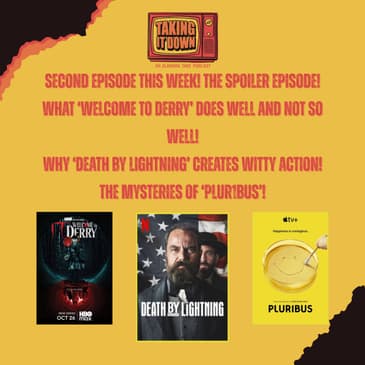





Taking It Down is back again in the same week for a Thanksgiving special wit all spoilers, so be careful and use the time stamps!
First, Blaine welcomes and gives an overview of the episode (0:02) before reminding everyone about this different podcast episode for Taking It Down (1:35).
Once Donovan joins, the two discuss how 'Welcome to Derry' from HBO has mixed merits (3:32). After that, they shift gears to Netflix's 'Death by Lightning,' as it has a witty and energetic narrative (21:15). The conversation then turns to Apple TV's 'Pluribus,' where they try their best to unravel its mysteries (33:46). To end, Donovan offers a brief thought on 'Frankenstein' which is now airing on Netflix (54:07).
For more, visit The Alabama Take website with this link.
To sign up for the site's newsletter, visit the link here.
To help both the podcast and The Alabama Take site itself, consider making a donation of any size with the link here.
Hey, and Happy Thanksgiving to you all.
Speaker AWhat are you thankful for?
Speaker AWhat makes you feel gratitude?
Speaker AHopefully it's something every day.
Speaker AYou do that Many times a day, I hope.
Speaker AThis is our second episode this week.
Speaker AIt's an odd episode where we'll only talk about spoilers on the things we've mentioned in our previous episode.
Speaker AYesterday we got two episodes out in one week.
Speaker AThat's kind of weird, too.
Speaker AWe here at Taking it down cover TV and streaming.
Speaker AAnd normally we do it in a bifurcated manner.
Speaker ASo you can hear the first segment as a bit of recommendation on a show or movie or whatever.
Speaker AAnd then on the back half, we dissect the shows or movies much more specifically.
Speaker ANot today, though.
Speaker AIt's all spoilers.
Speaker AWe ruined welcome to Derry on hbo, at least through three episodes that have aired, not all five, but three.
Speaker AWe'll discuss the historical thriller on Netflix, Death by Lightning, about President Garfield.
Speaker AIt's way better than it sounds.
Speaker AAnd finally, we try to wrap our heads around all of the four episodes of Pluribus, which is on Apple tv.
Speaker AIt may be why you're here.
Speaker AThanks for clicking play.
Speaker AMaybe you're cooking.
Speaker AMaybe you get the day off.
Speaker ALeaves are hitting the ground.
Speaker AYou ready for tv?
Speaker ASo here we go.
Speaker ALet me get Donovan to join me.
Speaker BAlabama, take projection.
Speaker AAnd here he is.
Speaker AIt's Donovan again, of course.
Speaker AWe were with you yesterday while you were cooking.
Speaker ANow you might be eating or cooking more.
Speaker AThanksgiving.
Speaker AI don't know.
Speaker AAre we thankful for anything?
Speaker AJust one more go round of Thanksgiving.
Speaker BYeah, thanks.
Speaker BThanksgiving.
Speaker BI'm thankful for my many streaming subscriptions.
Speaker AYeah, thankful for your nieces.
Speaker BAh, yeah, they're cute.
Speaker BI got nieces and nephews.
Speaker BThey're really cute.
Speaker AOh, nephew.
Speaker BI got two.
Speaker BTwo nieces, two nephews.
Speaker AOkay.
Speaker AThankful for our listeners, of course.
Speaker AThank you for listening.
Speaker ASo there's Don when he's with me.
Speaker AThis is our it was kind of weird this week.
Speaker AWe because it's Thanksgiving, because it's a little bit of a break, we we're doing all spoilers this episode.
Speaker AThere's your warning.
Speaker AIf there's something you want to hear, specifically find it.
Speaker AIt's time stamped.
Speaker AWe do a really good job of time stamping it so you can just click on it in your app.
Speaker AI use Apple podcasts, you use whatever.
Speaker AClick on that little highlighted number, the timestamp, and we won't spoil anything else for you other than what you're seeking.
Speaker AAnd we'll go in the same order we did yesterday, just with some exceptions that weren't didn't plan on talking about any in spoiler terms.
Speaker BSay spoiler.
Speaker BThe French get involved.
Speaker BThat's for the American Revolution.
Speaker AThat was the American Revolution.
Speaker BIf you listen yesterday, if you didn't know.
Speaker AIf you're watching the Ken Burns series, message us, hit us up.
Speaker AI'm gonna be interested to know.
Speaker AOr leave a comment on the side.
Speaker AThat's.
Speaker AThat's really the best way to do it.
Speaker AUnless you're just really private and you want to send an email, that's fine.
Speaker AForgive my congested sound.
Speaker AStill trying my best to boot that out of my system.
Speaker ALet's get to our first topic.
Speaker ALet's not waste any more time.
Speaker AIt is a it.
Speaker AWelcome to Dairy.
Speaker ANow, the setup here is.
Speaker AI have watched four of the five episodes that are out.
Speaker ADonovan has seen three of the four.
Speaker ASo we're really going to go as deep as three episodes.
Speaker AMaybe a little smattering of episode four, but not a lot.
Speaker ASo don't freak out if you haven't seen episodes four or five if you're playing catch up.
Speaker ASo here we go.
Speaker ALet's talk some specifics about welcome to Derry, based on the Stephen King book.
Speaker AIt in the two, really, the two recent films of the same name.
Speaker AI. I thought that third episode we're gonna really get into was a bit meddling.
Speaker BIt felt like it was setting up a lot of different things.
Speaker BEspecially, I felt like the first two episodes had had really kind of good centerpieces.
Speaker BAnd this one, it has a big extended sequence in a graveyard.
Speaker BAnd it's good and it's exciting, but I mean, I didn't, like, turn off my TV during the middle of it, you know, like, I hate this, but it felt like it was setting some stuff up.
Speaker ANow, we mentioned yesterday that we.
Speaker ASomething about it still makes us want to watch.
Speaker AI think it's just, where are they going to go with it?
Speaker AWhat are they going to do?
Speaker AHow are they going to try to scare us?
Speaker AWhat's the Air Force up to?
Speaker AI'm really.
Speaker AI don't know.
Speaker AI want to know that this episode's called now you see it.
Speaker AI don't know.
Speaker AIt's just sort of a wobbly episode than the first two.
Speaker AI thought the first two were mostly solid.
Speaker AMaybe it was the multiple timelines feeling a bit jarring or pieced together, stitched together without this, without some real glue between them.
Speaker BI was okay with that.
Speaker BAnd this is seeming to be.
Speaker BThis may be a feature, not a bug, but for some dumb.
Speaker BThis is just how my dumb brain works.
Speaker BThe whole Like Francis, the Air Force colonel.
Speaker BI think he's a general.
Speaker BHe's like, he doesn't even remember Rose, the indigenous woman, but girl that when he was a boy, he befriended.
Speaker BBut how does he have that dang slingshot if he can't remember?
Speaker BIt's something about the memory thing.
Speaker BMaybe I was like, you're gonna have to go more into this.
Speaker BI'm not sure if this works for me.
Speaker AAnd I think that's supposedly mentioned in one of the two films where I'm sure it.
Speaker AWhen you eat dairy, your memory is hindered.
Speaker BOkay, I'm sure it is, then.
Speaker BSo I'm.
Speaker BThis.
Speaker BThis may be just me being a neophyte for the.
Speaker BThe It.
Speaker BThe it Series.
Speaker BThe it universe.
Speaker BNot.
Speaker BNot really.
Speaker BI'm okay with it as a concept, but, like, the.
Speaker BLike.
Speaker BI'm like, how does it work?
Speaker BLike, how could he remember enough to bring, like, the Air Force in?
Speaker AIt covers.
Speaker AIt covers their.
Speaker ABut for.
Speaker AWhy doesn't the rest of the world know about this place?
Speaker BOh, yeah, I'm fine with that as a plot lick.
Speaker BAs a plot device.
Speaker BYeah.
Speaker BThat may be a completely invalid piece of criticism.
Speaker BThat's just the one thing that really stuck out for me.
Speaker BStill.
Speaker BEnjoy.
Speaker BChris Chalk.
Speaker AYes.
Speaker AWell, before I tell you what, before we move away from the flashback, the extended flashback, I suppose it wasn't a flashback.
Speaker AIt's probably a whole set of sequences.
Speaker AThey did this one thing that I've always found distasteful in Stephen King and his books.
Speaker BOkay, Movies, books.
Speaker AIs the dialogue.
Speaker AAnd I can even narrow it down to the dialogue of parents talking to children or older teens talking to younger teens.
Speaker AWhen the young Francis comes out scared to death of what he saw in the freak show, his father doesn't comfort him at all.
Speaker AWe've.
Speaker AI just don't feel like I've ever seen in a Stephen King book or movie a father go, it's okay, man.
Speaker AYou.
Speaker AYou're okay.
Speaker AAnd I know the time period, and I know, but it's like.
Speaker AIt's like 100% seriously.
Speaker AHis father says, don't be a damn sissy.
Speaker AAnd I would like to see some subversion of that writing or style to have him actually worried about.
Speaker AWhat.
Speaker AOh, what scared you?
Speaker AWhy.
Speaker AYou know, why would that scare you?
Speaker AIt's just a very good place for them to start thinking about and talking about fear and hinting that this is an entity that revolves around fear.
Speaker ABut I've always found it distasteful that.
Speaker AThat it seems like there's always a parent who's like, you know, pick it.
Speaker BUp, you son of a. I, I can't remember.
Speaker BI haven't read a ton.
Speaker BBut there's no shortage of poor parenting and the Stephen King, you know, Carrie's mother famously, was very good, was very good at her job.
Speaker AIt's one of his tropes, for sure.
Speaker BYeah, part of it.
Speaker BYou know, Blaine, I don't, I don't disagree or discount anything you said.
Speaker BPart of me just wonders if it's like, you know, conflict drives narrative.
Speaker BAnd so it's like, I wonder if that's why he's doing it, just because he writes so much.
Speaker BThese are, this is idle speculation.
Speaker BI don't think you're right, wrong, or that anything you said is, Is amiss.
Speaker AYeah.
Speaker AAnd King does it, of course.
Speaker AI just thought that the makers of this show had an open door here to say, ooh, let's do it the.
Speaker BOther way, and maybe that maybe they will.
Speaker BBut I do think that.
Speaker BAnd maybe, maybe they're going to be more explicit or I'll see more of it.
Speaker BBut I think you kind of mentioned it's a miss opportunity.
Speaker BBlaine.
Speaker BI think that there was kind of an, an interest, like, and it wasn't super duper explored, but like the, the fears that children, all children, but especially sensitive children have.
Speaker BAnd the way, you know, of course, we're often told by our societies, little boys especially, like, well, get over it.
Speaker BAnd it didn't really seem like.
Speaker BSo, like, if you're gonna have the dad be like, hey, don't be a sissy.
Speaker BHe met Rose and he had a scary encounter and it was all mostly okay.
Speaker BInstead of like, the way, like, you can almost be afraid of being afraid, you're ashamed of it when you're, you know, if you're told you're not supposed to be afraid.
Speaker BBut you know what, how are you supposed to feel as a child when you're put into a scary situation or, you know, the situation itself, I thought.
Speaker AWas well filmed and well done with the guy with the one eye, and he lights the match and, and he, he spooks him and he's a real presence.
Speaker AAnd then, of course, Francis goes out into the woods, meets the indigenous Rose.
Speaker AShe's a native of the area.
Speaker AAnd well before, you know, he meets her and they play and become friends and.
Speaker BYeah.
Speaker AAnd then the fear of that happening returns to him because the entity knows that's what he's afraid of.
Speaker BAnd.
Speaker AYeah, sometimes that's not that clear.
Speaker ASometimes you're like, oh, wait, was that the.
Speaker AYeah, Was that the entity in the freak show or not?
Speaker AYeah, sometimes it's not too clear and that's fine.
Speaker AI don't, I'm not griping about.
Speaker AI'm just saying that sometimes you sit there wonder that that's actually an okay thing.
Speaker BYeah, I think they, they want to do that.
Speaker BI think that's intentional.
Speaker AI suppose Will's parents are really kind hearted and normal.
Speaker BYeah, that's true.
Speaker AAnd we'll flip over to the good thing about this episode is that the interaction between Chris Chalk and Adepo as the two military guys.
Speaker AExcuse me, Air Force.
Speaker AWell, Air Force.
Speaker AMilitary.
Speaker BMilitary.
Speaker BYeah.
Speaker ASo Adepo has taken, let me call them both by character names.
Speaker BYeah.
Speaker ALeroy has taken Dick up into a helicopter for this purpose of.
Speaker ALet's, let's triangulate where this entity might be.
Speaker AThe military wants it for Cold War purposes.
Speaker AWe don't know really yet.
Speaker AAnd that's intriguing.
Speaker AThey want to harness it somehow.
Speaker ASo they take him up first time they've really done this because Dick can sense certain things and he does sense the entity.
Speaker AAnd he senses, if you're familiar with the movies or the book at all, you know, that he kind of gets to where he, the entity normally stays underground and he gets a little bit of a peek at him at best before Leroy pulls him back into reality.
Speaker AI thought that was pretty good.
Speaker BI like that whole sequence.
Speaker AI did too.
Speaker BI like Chris Chalk as part of it.
Speaker BAnd I thought it was actually frightening.
Speaker BLike being in a.
Speaker BLike being in a nightmare is inherently frightening.
Speaker BAnd maybe this is just the kind of nightmares that I've had.
Speaker BBut like I have had nightmares where it's like, oh, I'm, I'm like I'm trying not to be seen by something, you know, I'm trying to hide.
Speaker BAnd that's what he expressed that it had seen him.
Speaker AIt's certainly a character trait he would want because he has this special ability and if he lets too many people know, he's going to get used, killed, hurt.
Speaker BYeah.
Speaker ABut it gives us the later conversation where Leroy and Dick sit at.
Speaker ADick Halloran comes over, has dinner with off base.
Speaker AYou get the sense that's something he doesn't do a lot.
Speaker AAnd they're trying to establish a friendship.
Speaker AAnd I liked it because you get these two actors talking about who they are.
Speaker AWell, you know, where are we in this?
Speaker AWhat's.
Speaker AWhat do you see?
Speaker AWhat do I see?
Speaker AWhat's real, what's not.
Speaker AAnd I like that because apparently Leroy's character, we mentioned this before, he can't feel fear.
Speaker ARight.
Speaker ASomething about an injury he has had.
Speaker BHis, his amygdala has been damaged.
Speaker AYeah.
Speaker BSo he's not suicidally reckless, but he's not afraid.
Speaker AIs that a real thing that could happen to someone?
Speaker BI mean, I don't know.
Speaker BProbably if you.
Speaker BMy understanding is the amygdala is fairly central.
Speaker BFolks that know that didn't.
Speaker BThat actually paid attention in anatomy and physiology.
Speaker BPlease correct me if I'm wrong, but.
Speaker BAnd I think they kind of allude to this in the first episode is that I think if your amygdala just where it's located in the brain, I think a lot of other things would get damaged as well.
Speaker BSo I don't think you would be.
Speaker BOh, I mean, I'm sure there are people out there who've been hurt in a way such as not to feel fear, but I do not believe that those people are high functioning military air force majors.
Speaker BYeah.
Speaker BI think there's a reason we feel fear and that the amygdala is pretty central to our brain.
Speaker BSo I think you would really hurt your.
Speaker BYou would be severely brain damaged if you had something entered that era area.
Speaker AYeah.
Speaker ABecause this is a show and it might go multiple seasons if HBO lacks its viewership.
Speaker AThey could really explore that kind of thing.
Speaker AThey could really dig into why do we have fear?
Speaker AWhere does that come from?
Speaker AWhy do we imagine things?
Speaker AAnd it makes us fearful, evolutionary, you know, speaking.
Speaker BBut it's kind of the ultimate question of horror.
Speaker BRight.
Speaker BLike we have enough to be scared about.
Speaker BWhy do we invent new things to be scared about?
Speaker AYeah.
Speaker BWhen sometimes there's new things.
Speaker BOf course, the, the answer is those new things that we're scared about are ways to talk about the old things we're scared about.
Speaker AYeah.
Speaker APractice and rehearsal, maybe.
Speaker BYep.
Speaker BWell, you know how little kids reenact things through play.
Speaker BIf they see you talking on the telephone and, and having a conversation, they'll pretend, you know, that it' you know, you talking to a friend.
Speaker BRight.
Speaker BAnd they'll mirror your language.
Speaker AThey'll poop their diapers.
Speaker BExactly.
Speaker BMaybe.
Speaker BMaybe grown ups.
Speaker BMaybe we do the same thing too, you know, through plain imagination.
Speaker BWe work things out.
Speaker ADid you get a lot out of their conversation between Leroy and Dick when they were alone and Leroy's wife was inside the house?
Speaker ASo they get a chance to say, you know, who are you?
Speaker BExactly.
Speaker BThey get a chance to go one on one and kind of try and size these each other up.
Speaker AI like that.
Speaker ADick says you're the kind of guy who doesn't feel fear.
Speaker AAnd I'm not going to mess with you.
Speaker BYeah, yeah.
Speaker BDick is smart enough to opt for self preservation when it comes to the major.
Speaker BYeah, exactly.
Speaker BWe feel fear for many of the same reasons.
Speaker BWe fear.
Speaker BWe feel pain.
Speaker BRight.
Speaker BLike there are people who can't feel pain and they're incredible.
Speaker BThey're in incredible danger every day of their life.
Speaker BYou know, these.
Speaker BThey can.
Speaker BThese are people who will put their hand on a hot stove and not realize it.
Speaker BRight.
Speaker BAnd actually end up really.
Speaker BSo I think there's something kind of like.
Speaker BI'm kind of with Dick there.
Speaker BThat there's something kind of fearsome and scary.
Speaker BYeah.
Speaker BAbout a man who can't feel fear.
Speaker ARight.
Speaker BWhich I.
Speaker BAnd I liked that that's the way I feel about it.
Speaker BI felt like Chris Chalk is doing a good way of, you know, like, not that Dick is not a human being, but there's like, in a way he's not a human being like the rest of us.
Speaker BBecause everybody else can feel fear.
Speaker ARight.
Speaker ABut Dick can sense things.
Speaker AHe has this.
Speaker BYeah, Sorry, did I say Dick?
Speaker BI meant Leroy.
Speaker BSorry.
Speaker BDick feels that way about Leroy.
Speaker BAnd Dick can say, yeah, Leroy is not a human being in the same way that the rest of us are in the sense that he can't feel fear.
Speaker BWhereas Dick, even though he has extra sensory perception, he's still very much a human being in the same way that we understand human being and human existence to be.
Speaker BBecause we just had a.
Speaker BIn that great nightmare scene, him feeling fear.
Speaker AYeah.
Speaker BI like both of these actors too.
Speaker BAnd I think they did a good job just in the scene playing.
Speaker BPlaying off of each other.
Speaker BI do too.
Speaker AAs good as the kid actors are.
Speaker AAnd I think they've done a good job of picking them and not.
Speaker AThe casting director did a great job of.
Speaker AOf deciding upon who will be the.
Speaker AThe four kids.
Speaker AIt's still fun to see these two.
Speaker AYeah.
Speaker BAnd we'll see if the show's smart enough to follow up on this.
Speaker BBut you were kind of talking about dads.
Speaker BLeroy obviously is feeling like he doesn't understand his son.
Speaker BBut unlike the father at the fair, he's trying to reach out to him.
Speaker BHe's trying to accommodate him.
Speaker BSo maybe there's something there too.
Speaker BYeah.
Speaker BFear and support or lack of it.
Speaker APerhaps I overlooked that purposeful juxtaposition.
Speaker BThere could be or could be a missed opportunity.
Speaker BBlaine.
Speaker AI don't know.
Speaker AYeah.
Speaker AThe other thing that felt forced to me was this overuse or bad CGI for the one eyed man in the woods and the ghosts the kids encounter at the end of the graveyard.
Speaker AI just thought to myself, have we not improved how ghosts look since Ghostbusters in 1984?
Speaker BMan in the woods.
Speaker BFine.
Speaker BYou know, it's a scary monster.
Speaker BI get it.
Speaker BIt's cheaper.
Speaker BBut there was a little bit of the haunted mansion to the ghosts.
Speaker BYeah.
Speaker BYou know what I mean?
Speaker ATotally.
Speaker BAnd, yeah, maybe that was intentional, because I do think.
Speaker BI mean, there's.
Speaker BBut it's hard to tell.
Speaker BLike, sometimes the show is very, very dark with its kids, and sometimes there's sort of the element of like, hey, gee whiz, we're having an adventure, you know, So I don't maybe.
Speaker BI don't know.
Speaker BThat fell more on the gee whiz, we're having an adventure side of things for me, as opposed to, say, Lily's dad in the grocery store, which I found deeply unsettling.
Speaker AYeah.
Speaker AFrom episode two.
Speaker BYes.
Speaker AIt's probably interesting that I still look forward to it each Sunday.
Speaker AA lot of it has to probably do with the sincerity of the acting, which is odd because a lot of this hinges on one set of characters seeing the unbelievable and a whole other set of characters having to believe them for long stretches.
Speaker AYeah.
Speaker AYou wonder if horror wouldn't be better off if everyone just believes there were ghost and evil entities right from the jump.
Speaker BAnd someone.
Speaker BNot someone.
Speaker BSome horror does go that direction.
Speaker BIt is kind of like if you.
Speaker BIf you.
Speaker BI have read many a horror short story, Blaine, and I've read many a ghost story, and there does get to be a certain repetitiveness if you have stories where it's like, but ghosts can't be real.
Speaker BRight.
Speaker BLike, at a certain point, you're like, I'm reading a horror story.
Speaker BWe all know it's a ghost.
Speaker BThat's not to say which.
Speaker BWhich is not to say that it.
Speaker BPeople who disbelieve in ghosts and horror stories are fine, too.
Speaker BIt's a.
Speaker BWell, a well written story can use any combination of tropes, but, you know, sometimes you're like, oh, we gotta go through the mandatory, like, nobody believes the kids phase.
Speaker BYou know, like.
Speaker ARight.
Speaker AAny prediction on how they're wanting to use this against Russia?
Speaker BI mean, if you.
Speaker BIf something could make you so afraid that it would literally kill you.
Speaker AYeah.
Speaker BYou could probably do a lot of.
Speaker BOf harm with that.
Speaker AGuess so.
Speaker BYou know, it's more.
Speaker BI weaponize it and deploy it at a large scale, is my guess.
Speaker AI don't know.
Speaker ABe interesting to see how they try.
Speaker BAll right, we'll see what Happens.
Speaker ABut that takes us to Netflix this series, Death by Lighting.
Speaker AIt's produced by Benioff and Weiss.
Speaker AI'm not sure how much of a hand they had in it.
Speaker AThey, of course, were major creators and writers on Game of Thrones.
Speaker AAnd this series, Death by Lightning, just has a host of actors that do it in every scene.
Speaker BThere's really not a lot of downtime.
Speaker AThere's nothing for a historical drama or.
Speaker BThriller because everyone is so good, is so good in it.
Speaker BThere's like.
Speaker BYou're not like, oh, these guys.
Speaker BAgain, everyone's great.
Speaker BLike, all the actors are so good.
Speaker AOne thing I really love is that in the second episode, when it comes to Chester Arthur, the series makes it a point to demonstrate that people who are dedicated and effective at politics are usually the corrupt bastards you wish weren't in office for 50 years.
Speaker BThere's a real.
Speaker BI liked Arthur.
Speaker BThere's a real.
Speaker BLike, he's a buffoon at times.
Speaker BHe's obviously kind of the hatchet man, but there's like a.
Speaker BThere's a sadness to him at some points, too.
Speaker BNick Offerman's doing a great job as someone.
Speaker BHe's doing a great job.
Speaker BI don't even almost know how to describe it.
Speaker BLike, there's some times where he seems disappointed with himself.
Speaker BThere's points where he's just drunk and it's funny and, you know, like, there's.
Speaker BHe's like a bull in a china shop.
Speaker ATotally.
Speaker AIsn't it weird that history reminds us that it takes history maybe sometimes to remind us that politicians have been money grubbing assholes for as long as there's been politics?
Speaker BThere's an Onion article that, like, the headline is nations historians ask people to look at the past, think about that happened then, and then ask themselves about the present or something along those lines.
Speaker BAnd it is kind of true.
Speaker BRight.
Speaker BLike, there's the nothing new under the.
Speaker BLike, this wasn't just invented.
Speaker AYeah.
Speaker BYou know, like as long as there has been power and those who can hold it or those who would rather take a shortcut or have a little more or have all of it.
Speaker AYeah.
Speaker AAnd then there's the paint.
Speaker AHow they painted Charles Coteau.
Speaker AHe's not only delusional, but he's.
Speaker AThis guy is desperate for something, anything.
Speaker BYeah.
Speaker AThe Matthew McFadden plays him with such a twitchiness, you know, no one in their right mind would associate with him for too long, yet there's some sympathy there for him because he just wants his place in the world.
Speaker BI mean, he is absolutely like, he's tragic.
Speaker BI mean, I think Matt McFadden did a great job.
Speaker BYou know, there's the mix of, like, childlike naivete about him.
Speaker BYou can see that he's deluded, and he's constantly.
Speaker BHe's like a constant striver.
Speaker BRight.
Speaker BLike, he's constantly coming up with something else that's gonna work, and then in his own mind, he's almost already achieved it.
Speaker BThere's, like a.
Speaker BThere's just a sadness.
Speaker BThere's a sadness to him.
Speaker AYeah.
Speaker BYou know, very.
Speaker AIt's a deep and dark sadness you don't get with a lot of characters.
Speaker BAnd, you know, he does such a good job of playing him as, like, you know, as he does with many of the characters in this show.
Speaker BBut if this was the guy that came up to you on a street in the city, you'd be like, buddy, I need to get out of here.
Speaker BLike, you know, like, I got to get away from you somehow.
Speaker BSomehow.
Speaker BBecause you're just.
Speaker BYou're not gonna stop.
Speaker AIt's so good to have him in here, because this is history.
Speaker AI'm guessing, but Garfield was a man who seemed to know his place.
Speaker AI'm a man who owns a farm.
Speaker AI need to work this farm.
Speaker AI need to be with my family.
Speaker ABut Kateau was lost at sea all the time.
Speaker BHe's looking for something, like you said.
Speaker BAnd that's.
Speaker BSomething is clearly many different things.
Speaker BAnd, I mean, and this is.
Speaker BAnd it's like, it's not.
Speaker BIt is pathos.
Speaker BBut, like, there's humor, too.
Speaker BLike the bit where, like, they.
Speaker BIn the third episode, they illustrate just how annoying Guiteau is.
Speaker BWhere he's in the Free love colony in Oneida, and.
Speaker BBut no one will have sex with him.
Speaker BHe's constantly surrounded by.
Speaker BAnd it's funny.
Speaker BIt is, but it's sad, too.
Speaker BLike.
Speaker BBut, like, who?
Speaker AYou.
Speaker BYou wouldn't want to spend 10 minutes with this guy.
Speaker AAnd as far as Guiteau goes, McFadden truly has to look down.
Speaker AHave you seen pictures of him?
Speaker BNo, I haven't.
Speaker BI guess I should look it up.
Speaker AThere may be just the one, but he looks just like him.
Speaker BI feel like I almost don't have words for how much I appreciate what he's doing with his performance, because it just.
Speaker BThere is something.
Speaker BLike, it makes you.
Speaker BHe makes you really feel something.
Speaker BAnd it's that those different shades of complexity where he's.
Speaker BYeah.
Speaker BIt's like you feel bad for him, but also he's delusional, but also, you know, like, there's you know, sometimes he seems truly good natured.
Speaker BOther time, you know, definitely written and played.
Speaker AMore than one note, for sure.
Speaker BYou know, because there's, you know, in some ways he's innocent, harmless, and in other ways, he's going to take your money.
Speaker BYou know, he's going to break.
Speaker BHe's going to break in, he's going to bother you.
Speaker BHe's got, you know, like there's the bit where he's the good uncle playing with his nephews or his nephews and nieces, I don't remember, and obviously loved by them and his sister.
Speaker BAnd then there's the kind of darker side to him that he steals their money, that he steals their money and other unsavory things that he does.
Speaker BAnd we know from the get go that he's gonna kill someone.
Speaker AYeah.
Speaker AThe producers and directors also understand that for history to appeal for you to be engaged with it, you have to ensure that everyone understands that these historical characters were larger than life.
Speaker ASo you employ your Bradley Whitford, your Nick Offerman, Michael Shannon, Betty Gilpin.
Speaker AYou got to get somebody who's going to be like, oh, okay, I get it.
Speaker AI would vote for him.
Speaker BYes, I agree.
Speaker BThey did a good job for me, too.
Speaker BAs someone who personally doesn't know very much about this period in American history beyond what I think, you know, like what a high school education would get you.
Speaker AYeah.
Speaker BI feel like they've done a good job of giving me a good sense of what's going on.
Speaker BAnd I think part of that comes with the characters, too.
Speaker BRight.
Speaker BLike, you have just the way it's done and introduced very organically.
Speaker BI felt like the different characters, by their nature, drew out, like, the concerns of the time.
Speaker BRight.
Speaker BLike, Garfield is worried about corruption, and so Sherman comes to him and they're going to basically have it.
Speaker BHe's basically a symbolic candidacy.
Speaker BRight.
Speaker BAnd, like the wheeling and dealing of just these two men, not really wheeling and dealing, but like, talking and negotiating.
Speaker BDid a good job of not only showing you.
Speaker BOkay, here's who, Arthur.
Speaker BI mean, here's who Garfield is, but just the like.
Speaker BAnd if you didn't know much about this time period, President Grant was accused of selling offices, you know, to France.
Speaker BSo very deftly handled, I thought, for something.
Speaker BBecause it is very short.
Speaker AYeah.
Speaker BYou know, there's not.
Speaker BIt's not expansive.
Speaker BThere's.
Speaker BThere's are.
Speaker BThey don't have a great span of time to work with.
Speaker BThere's only a few episodes.
Speaker AWell, you gotta admire a man who says he'll Campaign from home.
Speaker BI.
Speaker BThis made me want to learn more about James.
Speaker BI'm like, is any of this true?
Speaker BThis makes me like James Garfield.
Speaker AYeah, some of it, I think is.
Speaker AIs quite true.
Speaker AYeah.
Speaker AAnd as CGI as they are, these sets in New York, old New York, still look so good.
Speaker BYeah, they do pretty good job.
Speaker AIt's exciting to see the harbors that you probably have seen, but in that era, that time period is pretty well done.
Speaker AYou get a sense of what it's like that you won't ever get anywhere else.
Speaker BYeah, well, you know, especially a place like New York City, most of it's been knocked.
Speaker BYou know, if you're in Manhattan, most of it's been knocked down.
Speaker BIt's not there anymore.
Speaker BYou know, like you said, it's not there anymore.
Speaker AI think that they do a very good blend.
Speaker AI've seen some complaints.
Speaker AThe blend isn't quite balanced, but they do a good blend of the language seems right some of the time, but.
Speaker ABut yet they keep the rest of it at a clip.
Speaker BYou know, to my ear, I don't.
Speaker BI could see how some people maybe would complain about it, but to my ear, it worked.
Speaker BSometimes there is a bit of, you know, like the phrasing seems a little quaint or old fashioned, but it's never distracting or slows it down.
Speaker BAnd sometimes, you know, people will speak very modern colloquial English.
Speaker AYeah.
Speaker BAnd it works for me.
Speaker BIt's a blend.
Speaker BI understand that.
Speaker BI, you know, it's giving me kind of a flavor for things.
Speaker BI am able to understand that I'm not watching something for full historical accuracy here.
Speaker BRight.
Speaker BIt is drama.
Speaker BThere are things that are made up.
Speaker BThat's okay.
Speaker BIt's telling because it's speaking about.
Speaker BIt's not wanting to just be a faithful historical reenaction.
Speaker BRight.
Speaker BIt's also got its own purposes.
Speaker AYeah.
Speaker AWhen Senator Blaine scoffs at the vice presidency, he says, that's an insult.
Speaker AIt's the vice presidency that's really good.
Speaker AAnd probably not how he would say it there.
Speaker AAnd then you get these turns of phrases that are almost eloquent of the.
Speaker AAnd reminiscent of maybe what that era would be.
Speaker BYeah.
Speaker AI really like the writing as far as just the simple dialogue of it all.
Speaker BDialogue is very good.
Speaker BI think I agree with you.
Speaker BThe characters are identified very well by their language.
Speaker BGarfield's a little slower to speak.
Speaker BSome of his phrases are a little bit more antiquated.
Speaker BWhereas, you know, Conklin is very, very brash, very modern.
Speaker BYou know, he's.
Speaker BHe's he's swearing, he's, you know.
Speaker BYeah.
Speaker AThere's so much that are flip sides of each other and I guess that's how history just sort of played out maybe.
Speaker ASo it was a good idea to mine this for a show.
Speaker AGarfield's simple, but he's asked to be president.
Speaker AChester Arthur is a ruffian, but he's humbled to be vice president.
Speaker AGuiteau wants to be a man of import, but he's going about it in.
Speaker BSuch dishonorable ways, he doesn't even know what he's asking.
Speaker BThe scene where he finally meets Garfield, it seems like he doesn't even know what to ask for.
Speaker AThe dog that catches the car.
Speaker BExactly.
Speaker BLike, it's like this is his big shot.
Speaker BAnd Matthew McGh, he does such a good job just playing like that scene is almost painful to watch because you're just like, he's blowing it.
Speaker BAnd of course you never thought he would pull it off, but it's just like he's floundering.
Speaker BHe doesn't know what he wants.
Speaker AWell, these are the moments where he.
Speaker BJust wants to be important.
Speaker AWhere Garfield opened the doors of the White House and welcomed in the public during certain hours of the.
Speaker AOf the day.
Speaker ADo we need more of that today?
Speaker BI think that the assassination of James Garfield is one of the reasons we don't do it anymore.
Speaker BBut yeah, honestly, I do think that like you, you know, it's kind of like when you're like your congressperson comes home and then they try and duck their constituents because their constituents are mad about what they did.
Speaker BIt's like, you know, you represent all the people, not just the people you voted for.
Speaker BYou represent or I mean everybody.
Speaker BThe people who voted for you.
Speaker BYou represent everyone.
Speaker AAnd you don't hear that enough.
Speaker BNah.
Speaker AThere's a moment in the fourth episode where they talk about.
Speaker AThey probably talk about things that they didn't in reality and where they're saying, you know, how.
Speaker AHow will history recognize us?
Speaker BYeah.
Speaker AAnd I think that's a.
Speaker ABut maybe they did.
Speaker AThese guys are presidents and senators and maybe they did think that way.
Speaker BYou know, they lived through historically tumultuous.
Speaker BThese are all Civil War veterans.
Speaker BMost of.
Speaker BNot all of them, but a lot of them are Civil War veterans.
Speaker BThey lived through the Civil War, emancipation, you know, all that.
Speaker BThe assassination of a president.
Speaker AYeah.
Speaker BEverything that fought Reconstruction in the South.
Speaker BSo maybe, I don't know, maybe they do have a sense that maybe they have.
Speaker BHistory will have its eyes on them.
Speaker BI don't know.
Speaker AIt's A good moment.
Speaker AIn that fourth episode, we will move on to a show with a title of a very historical title.
Speaker APluribus e Pluribus Unum or whatever it is.
Speaker BI think you got it.
Speaker AIs that right?
Speaker BI think that's it.
Speaker BYeah.
Speaker AYeah.
Speaker BIt's not like it's on her coins.
Speaker BWho has a coin?
Speaker AYeah, well, I don't have any of that.
Speaker BExactly.
Speaker AI don't have any money.
Speaker ABlurbus on Apple TV got a lot of attention.
Speaker AIt's got a lot of headlines.
Speaker AStill is, I think.
Speaker AI think the question might be, will it.
Speaker AWill it hold that attention?
Speaker AThe first two episodes dropped at once, and it really was everywhere it felt like.
Speaker AAnd we'll concentrate mainly on the last two of the four that are out.
Speaker AGrenade and Please Carol.
Speaker AThat's the titles of them.
Speaker ADo you think it's got.
Speaker ADo you think audiences are going to be patient with this one?
Speaker AEnough.
Speaker BThat's kind of the trick sometimes with, like, this kind of high concept.
Speaker BMiss?
Speaker BWell, it's not really a mystery.
Speaker BIt's a little bit of a mystery, but.
Speaker ALittle bit.
Speaker BNot a lot, but a little bit.
Speaker BAre you just like, tell me, tell me, tell me, tell me, tell me what happens, or are you able to accept that you're watching a TV show that has to fill a whole season?
Speaker BYou know, like, they're not gonna give you everything in the first episode.
Speaker AThat's true.
Speaker AOf course not.
Speaker ABut we're all called up here, by the way, people.
Speaker APluribus.
Speaker AAll four episodes are on the table for spoilers.
Speaker AThere is some stretch to these episodes.
Speaker BThere is.
Speaker BI would.
Speaker BI would agree with that.
Speaker AWhich reminds me of Better Call Saul.
Speaker ALike, I'm gonna tell you what I'm gonna do.
Speaker AWait, wait, let me back up.
Speaker AI'm not going to tell you what I'm gonna do.
Speaker AI'm just gonna show you what I'm gonna do.
Speaker AAnd it's going to last the whole episode.
Speaker AAnd in this character's life, it.
Speaker AThat actually might be the 40.
Speaker AThe 45 minutes it takes to do whatever the thing is.
Speaker AOr it might take all day.
Speaker BBut, like, even in the fourth episode, we have the man in Paraguay.
Speaker BHe's somewhere in South America.
Speaker BI've forgotten.
Speaker BAnd we just see, like, for about 15 minutes of the show, we just see his routine.
Speaker BWe see what he's doing.
Speaker AWe have the cold open.
Speaker BYep.
Speaker BAnd we yell at the screen, do something.
Speaker AGet up and do something.
Speaker BI mean, yeah, we're all impatient these days.
Speaker BRight.
Speaker BLike, no one has any pace.
Speaker BBut I want to.
Speaker BAnd I think that patience will be rewarded.
Speaker BBecause I do.
Speaker BAnd I do think that, like, there's something more.
Speaker BI think I got more out of that scene of him setting a timer, clicking the radio on a frequency and waiting that I would have if he'd been like, you know, if it had been a minute or something like that.
Speaker BJust like I've been clicking this radio all day, you know.
Speaker BI don't know.
Speaker BDoes that make sense?
Speaker AIt makes perfect sense.
Speaker BI feel like having to sit with it, like.
Speaker BWell, sometimes in the.
Speaker BYou get a little antsy, but you're.
Speaker AYou get a little antsy.
Speaker ABut it's hypnotic too.
Speaker BIt is hypnotic.
Speaker BYeah.
Speaker AAnd it's well shot.
Speaker AYou know, you.
Speaker AYou get the close up, but the pencil touching the paper.
Speaker AIt's just something about.
Speaker BThis is.
Speaker BThis is the same with like, Carol's trying to dig a hole by herself.
Speaker BYou know, it's like.
Speaker BIt's like.
Speaker BWe know she's not gonna necessarily.
Speaker BLike, it's not the most fascinating thing in the world.
Speaker BShe's digging a hole.
Speaker BBut it puts you right there with the character.
Speaker AYeah.
Speaker AI didn't like grenade as much as I did the fourth episode, which it totally eludes me.
Speaker BPlease Carol.
Speaker BRight?
Speaker AWe.
Speaker AYeah, please Carol or Carol please.
Speaker BOr something like that.
Speaker BYou just said it.
Speaker AYou know, let's take a step back and set this up.
Speaker AWhich we never did because yesterday was our non.
Speaker ASpoiler episode and we.
Speaker AWe divided it up.
Speaker AThis is spoiler.
Speaker ASo we can talk about it.
Speaker ABut I mean, it's.
Speaker AI would say it's high concept and it's obviously high concept, but it's also kind of hard to understand.
Speaker ARight.
Speaker BYeah.
Speaker AThe idea is that scientists found these messages from space.
Speaker BRight?
Speaker AThese four kind of messages.
Speaker AAm I right about this?
Speaker BYeah.
Speaker BThey're like radio waves, frequencies, something.
Speaker AYeah.
Speaker BAnd it rewired our brains and then it's some.
Speaker ABut it didn't just rewire our brains.
Speaker AIt kind of set off a transferable sort of.
Speaker AI don't know.
Speaker ADisease is the only way I could think about it.
Speaker BIt is like a disease.
Speaker BYou know, you had the infection points.
Speaker BAll those people went on to infect other people.
Speaker BWe've seen this with zombies.
Speaker AYeah, it was a lot like that, except higher.
Speaker AHigher level thinking.
Speaker BIt's the invasion of the pod people.
Speaker BIt's a zombie apocalypse.
Speaker BIt's.
Speaker BExcept the next day, they're not actually trying to kill you.
Speaker BThey just want to get you breakfast.
Speaker AWell, they don't seem like they're going.
Speaker AThey do.
Speaker AIt's so questionable about what they're up to.
Speaker AAnd then of course, when you die in the show, your thoughts and memories become part of the collective humanity.
Speaker AEveryone's connected mentally.
Speaker AAnd you know, that's.
Speaker AThat's one of the main points happening in this.
Speaker AIn these early episodes with Carol.
Speaker BBut yeah, her.
Speaker AHer girlfriend and I think she kind of had a managing role.
Speaker BYeah, I think she helped with her career.
Speaker AYeah, she's really disturbed that they know Helen's memories.
Speaker AHer.
Speaker AHer girlfriend who has died due to this infection, invasion, connection, whatever you want to call it.
Speaker BAnd it's a very, I think, kind of like smart and primal fear, you know, because if you're everyone, aren't you really no one.
Speaker BThere's almost.
Speaker BIt almost is like questions or thoughts of, for instance, survival after death.
Speaker BRight.
Speaker BLike, if I am reabsorbed into the universe, am I okay with that?
Speaker BAm I still I?
Speaker BLike, is there any I to be okay with that?
Speaker BYou know, like, do I lose myself?
Speaker BIs this better?
Speaker BIs this worse?
Speaker AThere's not a little segment of you anymore?
Speaker AThere's not a little segment exactly, is there?
Speaker BWho knows?
Speaker BAre you the same?
Speaker BYou know, the people who have been integrated into this consciousness, are there really 3 billion people in there or is it just one person, one entity?
Speaker AWell, some of that gets answered in episode four, which we won't.
Speaker BSome of it does.
Speaker BBut I think that those are kind of still the under.
Speaker BLike, those are the questions that like trouble Carol and potentially us, right?
Speaker AUh huh.
Speaker BOr hopefully us.
Speaker BRight.
Speaker BCause we're, you know, Carol.
Speaker BThis apocalypse has turned into somewhat of a utopia.
Speaker BBut Carol's not on board, right?
Speaker AThe episode Grenade opens with a very prickly Carol and her girlfriend.
Speaker AGirlfriend slash manager Helen, taking in this really bespoke hotel in Norway made of ice.
Speaker AThe hotel's made of ice.
Speaker BAnd that was scarier to me than anything you can dream of.
Speaker ADude, I was not gonna hang there.
Speaker ABut Carol can't stop thinking about where her book is on the bestseller list.
Speaker AThis was years before when I guess her first one has come out.
Speaker AYou get the feeling she doesn't enjoy a ton of things.
Speaker BYeah.
Speaker BYes, I would agree with that.
Speaker AYou know, I kind of wanted this.
Speaker AAnd I love Rhea Seehorn.
Speaker AShe was so good at Better Call Saul and you pulled for her.
Speaker AYet here in this series, I wanted to say to her, enjoy it.
Speaker AAnd in modern day, Carol is on the plane from Spain with Zosa, I think her name is.
Speaker BIt's got.
Speaker AShe's kind of become her little helper, her guide.
Speaker ASince all this has happened, they've just Met the only people who did not get connected to the rest of the billions of the world after the alien signal.
Speaker BAll what, 12 of them?
Speaker B13, something like that.
Speaker BYeah.
Speaker AIt's a low number.
Speaker BIt's a very low number.
Speaker AThat's where you find out about the guy from Paraguay who you do end up seeing in the fourth episode.
Speaker AThere's.
Speaker AThere's some of this.
Speaker AFor it to work, well, I think you have to maintain this image of this feeling of love that we didn't really see much between Carol and Helen.
Speaker AYou know, Carol's burying her in the backyard, and that's harrowing and even touching sad.
Speaker ABut, you know, there's a believability.
Speaker ALike, how much did she care about Helen?
Speaker AI didn't quite see enough of that.
Speaker BActually works really well for me because, I mean, I'm fine if we see more of their relationship, but just being all in the aftermath and her grief and her.
Speaker BHer anger, like her anger and fear, seems really driven by that loss.
Speaker AYeah.
Speaker BBecause it's like, I lost an individual.
Speaker BLike, you're not a substitute for that individual.
Speaker BAnd that feels like it drives a lot of her decision, you know, Like a lot of her.
Speaker BHer grief and despair.
Speaker BLike, who.
Speaker BIf Helen was still alive and with her, maybe she'd be like those other families.
Speaker BHappy to.
Speaker BYou know, at least I can spend.
Speaker BYeah, can spend time with you in the.
Speaker BIn the flesh instead of, you know, you're dead and somebody else has your memories.
Speaker ACarol has to be really careful not to get angry with them.
Speaker AIt puts them into the convulsions, which were similar to how they got into this connection.
Speaker AIt may kind of injures or kill some of them who may be doing something like driving or flying a plane or something.
Speaker BIt's kind of great because it's like a psychoanalyst or a therapist would be like, I.
Speaker BThis is an unhealthy relationship.
Speaker BRight.
Speaker BLike, if you get mad at me, I'm going to have some of my people die.
Speaker BThat's what's gonna happen.
Speaker BLike, you can't lose your temper with me.
Speaker BYou can't express anger.
Speaker ARight.
Speaker BIs.
Speaker AI can't feel.
Speaker BFeels unhealthy.
Speaker AYeah, totally.
Speaker AThey can't lie.
Speaker AThey're willing to help to an extreme, but that just feels devious somehow.
Speaker AYou know, they give her the grenade.
Speaker AThe title of the episode.
Speaker BThey give her a real grenade?
Speaker AYeah, a real one.
Speaker BYeah.
Speaker AAnd she's like, what the hell are you doing?
Speaker BYou know, and she.
Speaker BShe asks, would you give me an atomic bomb?
Speaker BAnd they kind of hem and haw.
Speaker AYeah, do you want one?
Speaker AIt kind of.
Speaker BIt really makes you wonder, what kind of entity is this?
Speaker ARight.
Speaker BAnd is it.
Speaker BI don't know, maybe I'm completely, completely on the wrong track.
Speaker BBut is it the master or is it the servant?
Speaker AHow could it be the servant?
Speaker ATell me how that works.
Speaker BWell, why would it be so servile?
Speaker BWant to do nothing but please.
Speaker BThese individual personalities want to give them things like heroin, atomic bombs and hand grenades.
Speaker BIs this.
Speaker BThis.
Speaker BAgain, I could be completely out of left field here, but is this like this, this.
Speaker BThis creature, this entity, is it built to serve something else?
Speaker BIt has these instincts to serve and never lie.
Speaker BWhy would it have those when everything's just going to be itself?
Speaker AWell, it makes her old, the master for a while.
Speaker BThat's what.
Speaker BYeah, so I'm one.
Speaker BI'm just.
Speaker BI'm just curious.
Speaker BMaybe that's, you know, because it does.
Speaker BI wonder if it's like a tool of something else.
Speaker BBasically.
Speaker AYeah.
Speaker AThere's a lot to connect to, forgive my pun.
Speaker AConnect to what Gilligan's doing here.
Speaker AThey're robots.
Speaker AThey're unfeeling.
Speaker AIs he saying that's what we are?
Speaker AIs he saying life's uninteresting?
Speaker AIs he saying we're all acting like a cult these days?
Speaker AIs he saying that AI has turned us into this sort of thing?
Speaker BWell, you know, and I think there's the interpretation that's somewhat carried out.
Speaker BWe're always waiting for the other shoe to drop because we've seen, like Carol in the first or second episode says, like, we've seen this movie before.
Speaker BThere's a bit where it's like, would it really be so bad?
Speaker BThere's no more war.
Speaker BEveryone gets enough to eat.
Speaker BSuffering has mostly ended.
Speaker BIf you're in, you know, we can work to preserve the environment.
Speaker BYou know, it's like, is.
Speaker BIs it so.
Speaker BIs it so bad?
Speaker BWhat is us existing as individuals in the way that we do?
Speaker BIs that a good thing?
Speaker BI think it asks that too.
Speaker AIt's the only way communism's gonna work.
Speaker BYeah, Yeah.
Speaker BI mean, honestly, I mean, it's.
Speaker BWe talked about with death, death by lightning, right?
Speaker BLike, there's all like those.
Speaker BUnless there's some system we haven't found, like those.
Speaker BThere will always be those who, like, hoard and amass and take from others the haves and have nots.
Speaker BWhereas all of a sudden, there's no child's gonna go hungry in this new world.
Speaker AYeah, I found it odd that it started like an alien invasion almost and then it quickly went away from that.
Speaker AYou just don't see it quite.
Speaker AAlthough they're all acting like aliens, I.
Speaker BReally like that because it did feel like the.
Speaker BLike, we've seen this movie.
Speaker BWe're waiting for the other shoe to drop, and we are given this fear.
Speaker BAnd initially, very fearsome things are happening.
Speaker BPeople are convulsing, dying, crashing.
Speaker BAnd then it turns out it wasn't the end of the world after all.
Speaker BAnd Carol's stuck with that?
Speaker AWell, they're pretty certain she's gonna join them.
Speaker BYes.
Speaker BIt's a biological imperative, they say.
Speaker AIs it?
Speaker AI mean, that's a good question.
Speaker APluribus begs viewers to understand that Carol with a grenade, when she almost killed her God.
Speaker AZosa.
Speaker BZosa.
Speaker BYeah.
Speaker AIsn't just about Carol with a grenade.
Speaker AIf you watch this as a.
Speaker AAs, like, collective humanity is the algorithm and constantly trying to show you what it thinks you want.
Speaker AThat plays pretty hilariously as well as furiously.
Speaker BIt made me laugh in the fourth episode where our good friend Joel from somebody somewhere is.
Speaker BIs the representative of the entity.
Speaker AYeah, He's.
Speaker BAnd she's asking.
Speaker BShe's trying to figure out if it can lie, basically.
Speaker AYeah.
Speaker BAnd she.
Speaker BShe's trying to ask him what they liked about their books, and he's just like, everything.
Speaker BAnd it just.
Speaker BShe's like, you think I'm as good as Shakespeare?
Speaker BShe's like, every.
Speaker BYou know, it feels like the kind of.
Speaker BLike that the AI that, like, gasses you up.
Speaker BRight.
Speaker BLike, if you've ever put in a prompt, the AI Is like, wow, this question shows that you're a unique and creative thinker.
Speaker BExactly.
Speaker AAnd you believe it every time.
Speaker BI mean it.
Speaker BYou know, I read a very interesting essay by a philosopher named David Bentley Hart that said that we miss.
Speaker BThe real metaphor or story of AI is Narcissus.
Speaker BWho.
Speaker BYou know, Narcissus was cursed to fall so in love with his.
Speaker BHe was beautiful.
Speaker BRight.
Speaker BAnd he fell so in love with his reflection in the water that he wasted away and died.
Speaker BWhereas, you know, there's not anything really there, but we're projecting ourselves, the things we want to see, the things we like to hear, into these, you know, this basically math program.
Speaker BIt's narcissism.
Speaker ASo when we all hook up as one organism, there's nothing there.
Speaker BWell, I can't say about the one organism, but certainly when we, as individuals interact, I think a lot of, like, the AI, like, things that are happening because of AI, you know, especially, like, the social things you hear.
Speaker BYou know, people are Having girlfriends or whatever.
Speaker AOh, yeah.
Speaker BI think it says more about.
Speaker BIt says more about us than it says about the math program.
Speaker AIt says more about us than it does.
Speaker BWho.
Speaker BThe math program.
Speaker BUnderlying.
Speaker BUnderlying AI.
Speaker BYou know, it's just numbers.
Speaker BIt's just big numbers at an incredibly large scale.
Speaker BAnd I think that, like, you know, as someone who's like, maybe lonely and uses a chatbot and feels a connection, there's nothing on the other.
Speaker BThe chatbot has nothing to.
Speaker BSo obviously that's telling you more about the person who feels the connection.
Speaker AWhat a great metaphor Narcissus is.
Speaker BI liked it.
Speaker BIt made me.
Speaker BSo I thought there is maybe a little bit of that also.
Speaker BYou know, Gilligan's playing with a lot of things.
Speaker AA lot.
Speaker BAnd I think.
Speaker BAnd I think he's doing it very well.
Speaker BAnd I think that he's.
Speaker BWell, he.
Speaker BAnd the.
Speaker BCause it's not just him writing and he created it, but it's written and directed by other folks.
Speaker BAnd there's just like.
Speaker BIt feels like everything is very slipp so far, that there's not a lot to really.
Speaker BReally.
Speaker BIt does a good job of kind of putting you in Carol's shoes.
Speaker AYeah.
Speaker BYou get pretty frustrated, you know.
Speaker BYeah.
Speaker BThere's an almost.
Speaker BThere's an element of like, what would I do?
Speaker BYou know, you, as the viewer can, are also kind of, you know, judge judging, so to speak.
Speaker BYeah.
Speaker BYeah.
Speaker AThe third episode is kind of there to show us how much, if not everything, anything that the collective will do for Carol, for whatever reason.
Speaker AWe don't know why.
Speaker AAnd then in Please Carol, this is the fourth and most recent one I talked about.
Speaker AI love the way that Gilligan's able to set up tension through attention to detail to see that applied to more of a science fiction narrative.
Speaker BYeah.
Speaker AJust like Albuquerque.
Speaker ABetter Call Saul narrative.
Speaker BThis was.
Speaker BThis was exactly when you said, this is the better Call Saul episode.
Speaker BYeah, I see.
Speaker BYou know, because you're like.
Speaker BYou know, you're like, I think I know what she's doing.
Speaker BI'm not 100 sure what she's doing.
Speaker AYou know, she's testing the anesthesia on herself.
Speaker AShe's recording herself.
Speaker AAnd then, you know that you never know until she goes and tries it on.
Speaker AWell, she makes a mention of, oh, it's going to work, or this is what I want.
Speaker AAnd she tries it on Zosa to tell her, how do we reverse this?
Speaker AThat's happened.
Speaker AAnd she can't quite get it out of her before many of the people around surround her.
Speaker AAnd I don't know they don't threaten her, but they just keep saying, please, Carol, don't do this.
Speaker BIt's kind of scary, surreal.
Speaker BIt's unsettling.
Speaker AYeah.
Speaker AIt's that glazed over look in their eyes.
Speaker AWell, anyway, like, great scenes in Breaking Bad and Better Call Saul, you don't really know why the character's doing it, and then you just know there's going to be a payoff.
Speaker AKnowing that there's a payoff is why you hang in there.
Speaker AYou're just like, what's this?
Speaker BWhat's this?
Speaker AAnd Gilligan's doing that on a minuscule scale in each episode, but he's doing it on a long scale, too.
Speaker AOn a major scale, too, with the whole series.
Speaker BI think our interest, rightly or wrongly, I agree with you, Blaine, that it depends on, like, I'm expecting I'm gonna get something in episode 8 or 10 or however many.
Speaker AYeah.
Speaker BThat makes the wait worth it.
Speaker AWell done.
Speaker AFor Gilligan and the writers to have Carol both gay and having gone through conversion therapy, that says a lot in a short amount of time.
Speaker BAnd it gives you a big insight into why Carol might be a bit hesitant about the new direction humanity is taking.
Speaker AYeah.
Speaker BAnd why she might.
Speaker BShe might not exactly trust the official.
Speaker BYou know, we're all one.
Speaker BEverything's great.
Speaker AI'm really digging it.
Speaker AI did, you know, the third episode, I wondered, am I enjoying this?
Speaker AAnd then the fourth one I saw that I was.
Speaker ABecause of that cold open.
Speaker AI'm gonna go back to it.
Speaker AIt was so great.
Speaker AIf you've watched any of the shows that Gillian's done, you know, Carol is destined to meet up with him in an attempt at something pretty big.
Speaker BYeah.
Speaker BAnd, you know, for that cold open, I think, at least for me, probably you, too.
Speaker BI think pretty quickly, you're like, I bet she's gonna call him, like, right?
Speaker BLike you.
Speaker ALike, this is the moment where she calls him that.
Speaker BThis is the intersection.
Speaker BRight.
Speaker BSo you.
Speaker BYou have, like.
Speaker BIt's kind of.
Speaker BIt's teased.
Speaker BRight.
Speaker BBut it gets the same way, almost.
Speaker ACertainly with that last phone call.
Speaker ABecause that's something that the collect the others would never say.
Speaker BYeah, exactly.
Speaker ASomething like fuck your mother or something.
Speaker BYeah.
Speaker AIn Spanish, yesterday, we briefly mentioned Frankenstein.
Speaker AYou got any lingering thoughts on Guillermo?
Speaker AGuillermo del Toro's version of Frankenstein?
Speaker BGuillermo del Toro's Frankenstein is a movie that dares ask America.
Speaker BDo you like to parent?
Speaker AInteresting.
Speaker ASometimes, yes.
Speaker AIs that an okay answer?
Speaker BI think so.
Speaker AAll right, I may want to watch it, then.
Speaker AThis is the end of our episode.
Speaker AWe split you up in two.
Speaker AWe hope you enjoyed that way.
Speaker AWe won't do that again.
Speaker AWe'll just do our usual non spoiler.
Speaker ATake a break spoiler next week, I think, because we won't have as much.
Speaker ACould be Train Dreams, could be Stranger Things.
Speaker ABoth on Netflix.
Speaker AA lot of y' all have Netflix.
Speaker ASeems to be like, you know, Netflix is kind of the cable now.
Speaker AYeah, everybody got that.
Speaker ABut do you have the add ons?
Speaker BThat's the thing.
Speaker BNot everyone has the add ons.
Speaker BLike Hulu.
Speaker BNetflix.
Speaker AYeah.
Speaker BAll right.
Speaker BWell.
Speaker AOr Apple in this case.
Speaker ABy the way, I wanted to make mention before I say goodbye.
Speaker AWhat a pairing of Pluribus and severance.
Speaker BYeah.
Speaker AJesus.
Speaker AApple.
Speaker AAnd it's on Apple.
Speaker ALet's.
Speaker ALet's go ahead and throw that in there.
Speaker ADo you want to write your essay now?
Speaker BYeah, please.
Speaker ASo we've reached the end for Adam, for Donovan.
Speaker AWe're gonna have Adam back pretty soon.
Speaker AAnd I'm Blaine, and we hope that you're not overdoing it with the cranberry sauce.
Speaker BGoodbye.